Total Dynamic Head (TDH) Calculator
Enter the flow, the lift and rise, and the suction and discharge pipes to get the head your pump must deliver.
This total dynamic head calculator finds the head a pump must deliver for your piping system. You enter the flow rate, the suction lift and the discharge rise, the pipe material and size on each side, the pipe lengths and fittings, and any pressure at the ends. Friction loss in both pipes is worked out by the calculator itself, then added to the static head and pressure head to give the total dynamic head (TDH) in feet and meters, plus the equivalent pressure.
Running in your browser, it is free and needs no sign-up. As you type, results update, and nothing you enter gets uploaded. Common uses include picking a pump from its curve, checking an existing pump against a new layout, or finding which part of the system costs the most head. Treat the output as an estimate, and verify critical designs against the pump maker’s data.
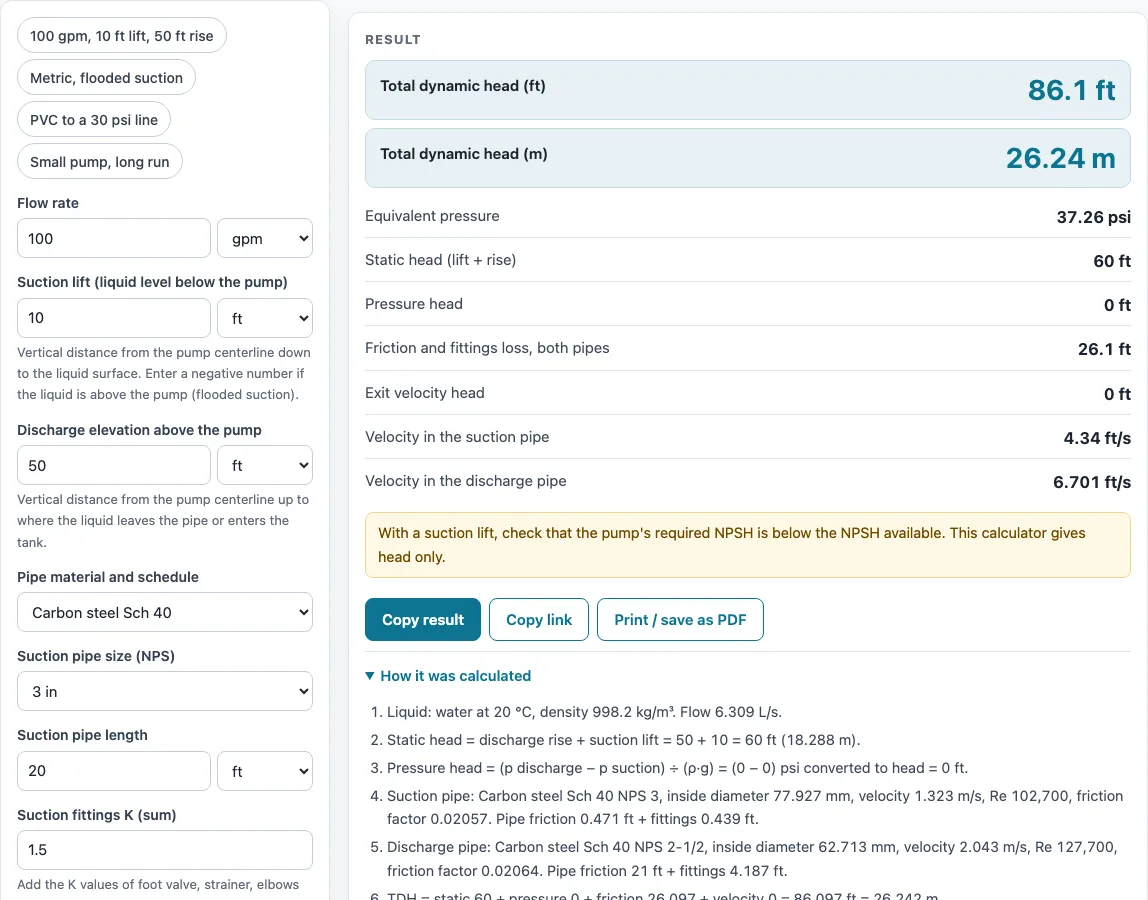
How to use the Total Dynamic Head Calculator
- Start by typing the Flow rate and picking its unit: gpm, L/s, m³/h, L/min, cfs, cfm, gal/h or MGD.
- Next, set the Suction lift, which is the vertical distance from the pump down to the liquid surface. If the liquid sits above the pump (flooded suction), use a negative number.
- Fill in the Discharge elevation above the pump, meaning the height from the pump up to where the liquid leaves the pipe or enters the tank.
- Pick the Pipe material and schedule, then add the NPS (nominal pipe size) and length for both the suction and discharge pipes.
- Sum the fitting K values on each side (foot valve, strainer, elbows, valves and tees). Use 0 to count straight pipe only.
- Expand More options to define the liquid (water temperature, seawater, or your own density and viscosity), the gauge pressure on the suction surface and at the discharge point, and whether the exit velocity head counts.
- Your answer appears as the Total dynamic head in feet and meters. Below it, a breakdown lists static head, pressure head, friction and fittings loss, and the velocity in each pipe.
- How it was calculated opens a step-by-step view with the values used.
Presets fill in typical cases, while Reset brings back the starting example. Copy result puts the result lines on the clipboard with a link, Copy link stores every input in the page address, and Print / save as PDF produces a one-page record.
What is the total dynamic head formula?
Total dynamic head is the work a pump does per unit weight of liquid, written as the height of liquid it lifts. The usual form adds four terms: TDH = static lift + pressure head + velocity head + friction loss. It follows from Bernoulli’s equation.
- Static head is the elevation difference between the suction point and the discharge point. Here it is the discharge rise plus the suction lift.
- Pressure head is the pressure difference between the two ends divided by the liquid weight density: (p discharge − p suction) ÷ (ρ·g). A gauge pressure of 30 psi at the discharge adds about 69 ft of water.
- Velocity head is v² ÷ 2g, the kinetic energy of the moving liquid. It matters only when the liquid leaves the pipe as a free jet. It is small in most systems, so the calculator counts it only when you tick the option.
- Friction loss is the head lost in pipe and fittings. The calculator uses the Darcy-Weisbach equation, h = f · (L ÷ D) · v² ÷ 2g, with the friction factor from the Colebrook-White equation, and adds K · v² ÷ 2g for fittings.
How do you calculate total dynamic head for a pump?
Take 100 gpm of water at 20 °C with a 10 ft suction lift, a 50 ft discharge rise, NPS 3 Schedule 40 suction pipe 20 ft long with K = 1.5, and NPS 2-1/2 Schedule 40 discharge pipe 300 ft long with K = 6. Static head comes to 10 + 50 = 60 ft. On the suction side, the flow moves at 4.34 ft/s and loses 0.91 ft including fittings. Discharge piping carries it at 6.70 ft/s, with 25.19 ft lost including fittings. Adding these gives 60 + 26.10 = 86.1 ft, or 26.24 m, which equals 37.3 psi for water. Read the pump curve at 100 gpm and pick a pump that delivers at least 86 ft there.
What changes for a flooded suction or a pressurized tank?
Enter a negative suction lift when the liquid is above the pump, because the liquid pushes into the pump and reduces the head needed. For a closed supply tank or a pressurized discharge, enter the gauge pressures under More options. Pressure on the suction surface helps the pump and lowers the TDH, and pressure at the discharge adds to it.
Does the calculator check suction conditions?
It gives head only. When there is a suction lift, it reminds you to compare the pump’s required NPSH with the NPSH available, and it warns if the lift plus suction losses reach the atmospheric head, which no pump can draw. The NPSH calculator covers that check.
Sources
- Definition and formula: Wikipedia, Total dynamic head (read October 2026)
- Friction: Darcy-Weisbach with Colebrook-White friction factor; pipe sizes from ASME B36.10M, ASME B36.19M, ASTM D1785, ASTM B88; water density from Kell (1975) and viscosity from IAPWS 2008 tables
Results are for estimation; verify critical designs against the applicable standard.
Worked examples
| Input | Result |
|---|---|
| 100 gpm, 10 ft lift, 50 ft rise, NPS 3 suction, NPS 2-1/2 discharge | TDH 86.1 ft (26.24 m) |
| 20 L/s, -2 m lift, 25 m rise, NPS 4 suction, NPS 3 discharge | TDH 175.4 ft (53.48 m) |
| 30 gpm, 0 ft lift, 20 ft rise, NPS 1-1/2 suction, NPS 1-1/2 discharge | TDH 96.58 ft (29.44 m) |
Calculated by the tool above with these values.
Frequently asked questions
What is total dynamic head?
Total dynamic head (TDH) measures how high a pump must lift liquid in total, counting both the pressure it has to add and the friction it has to beat. You read it off a pump curve at your flow rate.
Is TDH the same as pump head?
In most pump work, they are the same. Pump head, total head and total dynamic head each describe the energy given to every unit weight of liquid between the pump’s suction and discharge, expressed in feet or meters of liquid.
How do I convert TDH to psi?
Multiply the head in feet by 0.433 for water, or divide by 2.31. Using your liquid’s density, the calculator returns the equivalent pressure, so 86.1 ft of water at 20 °C is 37.3 psi.
Should I include fittings in the total dynamic head?
Yes. In a short pipe run, elbows, valves, strainers and tees can add friction head that makes up a large share of the total. Enter their K values in the fittings fields, and keep them at 0 only when you want straight-pipe loss alone.
Does TDH depend on pipe size?
Yes. Smaller pipe means higher velocity, and friction head scales with the square of velocity. In the 100 gpm example, NPS 2-1/2 discharge pipe loses 25.19 ft, so a larger pipe would reduce the total.
Can I use the results in commercial projects or client reports?
You may include the results in quotes, design notes, reports and client projects without attribution. Check critical designs against the pump maker’s data and the applicable standard, since this tool does not certify code compliance.
Related tools
- Pump Horsepower Calculator: converts head and flow into brake horsepower and a motor size.
- NPSH Calculator: confirms the pump will avoid cavitation at the suction side.
- Pressure Drop Calculator: isolates the friction loss of a single pipe.
- PSI to Feet of Head: turns a pressure reading into feet of water head.
- Hazen Williams Calculator: estimates water friction loss using the Hazen-Williams formula.
- Pipe Schedule Chart and Pipe Size Lookup: lets you check the inside diameter for a given pipe size.
- All pipe, pump and valve calculators: a full list of every calculator on the site, for browsing.