Steam Table Calculator (Saturated and Superheated Steam)
Type a pressure or temperature to read the steam properties from the IAPWS-IF97 equations, or print a full saturated steam table.
This steam table calculator gives you the properties of water and steam at any pressure or temperature you type, instead of making you interpolate between rows. Choose saturated steam from pressure, saturated steam from temperature, or superheated steam, and the tool returns the saturation temperature or pressure, the specific volume, the enthalpy, the internal energy and the entropy of both the liquid and the steam. A fourth option prints a full saturated steam table, by gauge pressure in US units or by temperature in SI units.
The properties come from the IAPWS-IF97 industrial formulation and are checked against the release’s own verification values and against NIST data. It runs in your browser, is free, needs no sign-up, and nothing you enter is uploaded. Every result is shown in SI units and in US units (BTU/lb, ft³/lb), so you can use it for boilers, steam traps, turbines and heat exchangers.
How to use the Steam Table Calculator
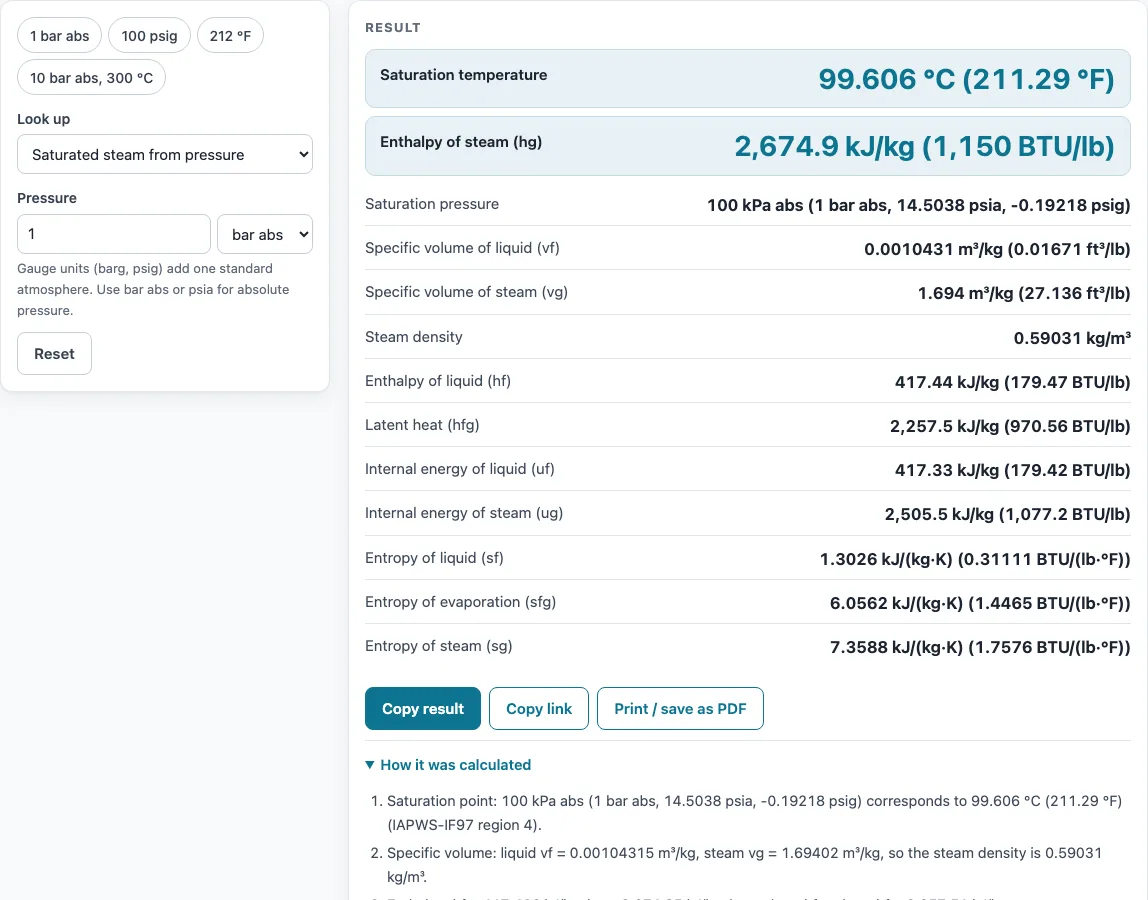
- Under Look up, choose Saturated steam from pressure, Saturated steam from temperature, Superheated steam or Full steam table to print.
- For pressure, type the value and pick its unit: barg, kPag, MPag, psig, bar abs, kPa abs or psia. Gauge units add one standard atmosphere to give the absolute pressure the equations need.
- For temperature, type the value and pick °C or °F. Saturated steam covers 0 °C to 350 °C. Superheated steam also needs a pressure, and its temperature must be above the saturation temperature at that pressure.
- Read the main result first: saturation temperature, saturation pressure, or the enthalpy and volume of superheated steam.
- Scroll the result list for vf and vg (specific volume of liquid and steam), hf, hfg and hg (enthalpy of liquid, latent heat and steam), uf and ug (internal energy), and sf, sfg and sg (entropy).
- For a printable table, choose Full steam table to print and pick the pressure table (psig and bar) or the temperature table (SI units), then use Print / save as PDF.
- Open How it was calculated to see the saturation point and the values step by step.
Preset buttons load typical cases, and Reset restores the starting example. Copy result copies the result lines with a link, and Copy link keeps every input in the page address.
What does a steam table show?
A steam table lists the properties of water along the saturation line, where liquid and steam exist together at one pressure and one temperature, and in the superheated region above it. The columns are the specific volume v, the enthalpy h, the internal energy u and the entropy s. The subscript f means saturated liquid, g means saturated steam, and fg is the change on evaporation. The latent heat is hfg = hg − hf. Internal energy is found from u = h − p·v.
What is the temperature of steam at 100 psig?
At 100 psig the absolute pressure is 114.7 psia (7.908 bar abs). Saturated steam at that pressure is at 169.93 °C (337.88 °F). Its enthalpy is hf = 718.9 kJ/kg for the liquid and hg = 2,767.8 kJ/kg for the steam, so the latent heat is 2,048.9 kJ/kg (880.9 BTU/lb). One kilogram of that steam fills 0.243 m³, a density of 4.12 kg/m³.
How do I read superheated steam?
Superheated steam is hotter than the saturation temperature at its pressure. At 10 bar abs the saturation temperature is 179.89 °C, so steam at 300 °C is 120.1 K superheated. Its specific volume is 0.25798 m³/kg, its enthalpy is 3,051.7 kJ/kg and its entropy is 7.1247 kJ/(kg·K). These agree with the NIST WebBook values for water at 1 MPa and 300 °C (3,051.6 kJ/kg, 7.1246 kJ/(kg·K)).
Which equations and limits does it use?
The calculator implements IAPWS-IF97, the industrial formulation for water and steam: region 4 for the saturation line, region 1 for liquid water and region 2 for steam. Saturated lookups run from 0 °C up to 350 °C (623.15 K, about 16.5 MPa). Superheated steam is supported up to 800 °C and up to the region 2 boundary. Above 350 °C the saturated liquid falls in region 3, which is not included. The reference state of IF97 sets u and s to zero for the liquid at the triple point (0.01 °C), the same basis as the common textbook tables.
Sources
- IAPWS, Revised Release on the IAPWS Industrial Formulation 1997 for the Thermodynamic Properties of Water and Steam (IAPWS R7-97(2012)): equations and verification values, which the tests reproduce
- NIST Chemistry WebBook, thermophysical properties of water (IAPWS-95), isobaric data at 1 MPa, read October 2026
- Unit conversions: 1 BTU(IT)/lb = 2.326 kJ/kg; 1 BTU(IT)/(lb·°R) = 4.1868 kJ/(kg·K)
Results are for estimation; verify critical designs against the applicable standard.
Worked examples
| Input | Result |
|---|---|
| 1 bar abs | T 99.606 °C (211.29 °F), hg 2,674.9 kJ/kg (1,150 BTU/lb) |
| 100 psig | T 169.93 °C (337.88 °F), hg 2,767.8 kJ/kg (1,190 BTU/lb) |
| 212 °F | p 101.418 kPa abs (1.01418 bar abs, 14.7094 psia, 0.013485 psig), hg 2,675.6 kJ/kg (1,150.3 BTU/lb) |
| 10 bar abs, 300 °C | h 3,051.7 kJ/kg (1,312 BTU/lb), v 0.25798 m³/kg (4.1324 ft³/lb) |
Calculated by the tool above with these values.
Frequently asked questions
What is a saturated steam table?
It lists the properties of water and steam at saturation, where the boiling temperature and the pressure belong together. Given either one, the other follows. This tool gives both lookups, and a printable table in the pressure and temperature forms.
What is the difference between psig and psia in a steam table?
Psia is absolute pressure, measured from a perfect vacuum, and psig is gauge pressure, measured above the atmosphere. Absolute pressure is gauge plus about 14.7 psi. Steam tables use absolute pressure, so a 100 psig boiler is at 114.7 psia.
What is hfg in a steam table?
The symbol hfg is the latent heat of vaporization, the heat needed to turn a kilogram or pound of saturated liquid into saturated steam at constant pressure. It equals hg − hf. At 1 bar abs it is 2,257.5 kJ/kg (970.6 BTU/lb).
Can I use this for superheated steam tables?
Yes. Choose superheated steam and enter a pressure and a temperature above the saturation temperature. The tool returns the volume, enthalpy, internal energy and entropy. If the temperature is at or below saturation it explains that the water is liquid or saturated.
How accurate are the values?
In the checks run for this page, the values agree with NIST’s IAPWS-95 data within 0.05 % at 1 MPa. At 1 MPa and 300 °C the enthalpy is 3,051.7 kJ/kg here against 3,051.6 kJ/kg from NIST.
Does it include specific heat of steam?
No. This page covers volume, enthalpy, internal energy and entropy only.
Related tools
- Steam Pipe Sizing Calculator: use it to pick a pipe size for a steam flow, with condensate load for traps.
- Pipe Velocity Calculator: use it to check the velocity of steam or liquid in a known pipe.
- Pressure Drop Calculator: use it to find the friction loss of water in a pipe run.
- Relief Valve Sizing Calculator: use it to size a relief valve for steam or gas service.
- Mass Flow Rate Calculator: use it to convert a steam volume flow to mass flow with the density you read here.
- Pipe Schedule Chart and Pipe Size Lookup: use it to check pipe wall thickness and inside diameter.
- All pipe, pump and valve calculators: use it to browse every calculator on the site.