Steam Pipe Sizing Calculator
Enter the steam flow and pressure to get the pipe size and velocity, or switch to condensate load to size the steam trap capacity.
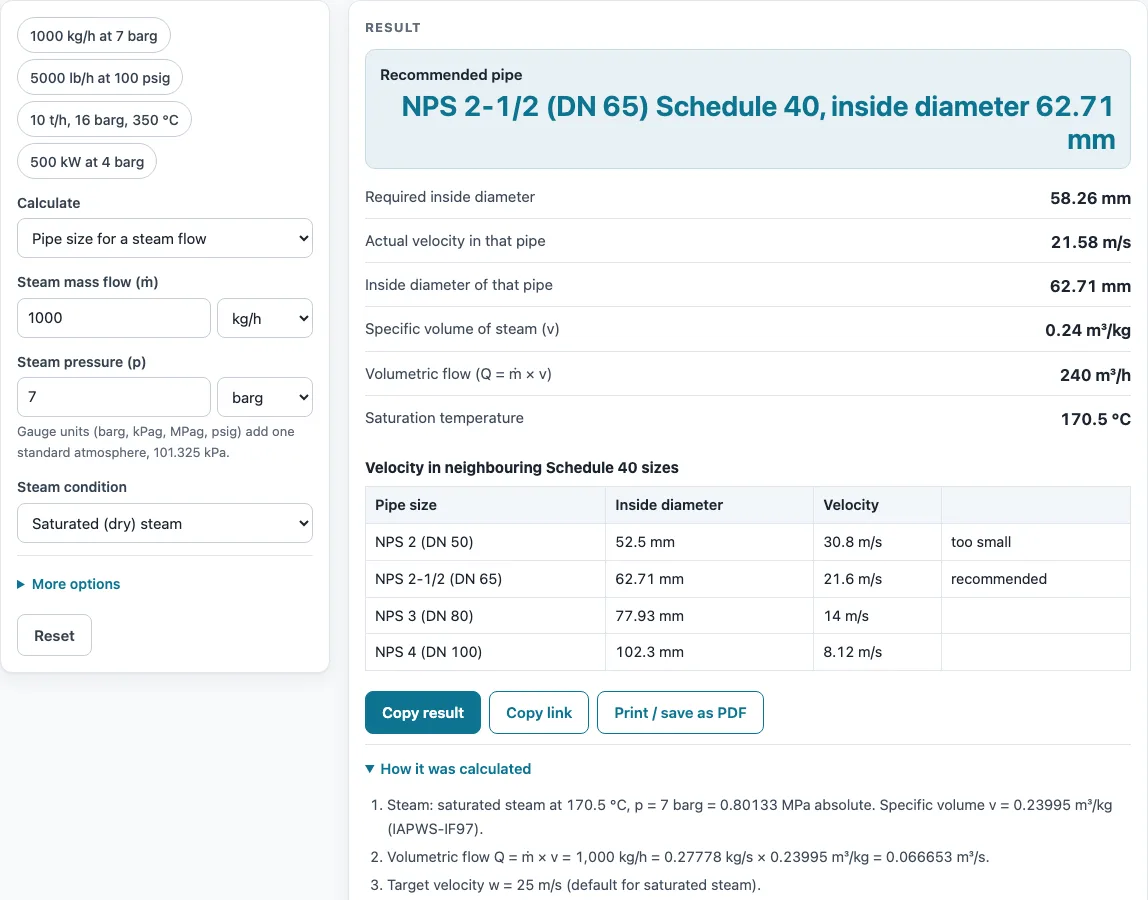
How to use the Steam Pipe Sizing Calculator
- Under Calculate, choose Pipe size for a steam flow or Condensate load (trap sizing).
- In pipe-size mode, enter the steam mass flow and pick its unit: kg/h, lb/h, kg/s, t/h or lb/s.
- Enter the steam pressure and pick its unit: barg, kPag, MPag, psig, bar abs, kPa abs or psia.
- Select saturated or superheated steam. For superheated steam, enter the temperature in °C or °F.
- Optional: open More options to set the target velocity (m/s, ft/s or ft/min) and the pipe schedule (40 or 80). If you leave velocity empty, the calculator uses 25 m/s for saturated steam and 35 m/s for superheated steam.
- Read the result: the recommended pipe, its inside diameter and its actual velocity. The size table compares the recommended pipe with one smaller and two larger sizes.
- Open How it was calculated to see the formula, the values substituted and the answer with units.
- In condensate mode, enter the heat duty (kW, MW, BTU/h, MBH or hp), the pressure and the safety factor.
Preset buttons above the form load typical cases, and Reset restores the starting example. Copy result copies the result lines with a link. Copy link stores every input in the URL, and Print / save as PDF creates a one-page record.
How does the calculator size a steam pipe?
The calculator finds the specific volume v of steam at the entered pressure, then multiplies it by the mass flow to get volumetric flow, Q = mass flow × v. It divides Q by the target velocity to get the flow area, A = Q / velocity, and then calculates the inside diameter, D = sqrt(4A / π). Steam properties come from the IAPWS-IF97 formulation. Worked example: 1,000 kg/h at 7 barg has v = 0.23995 m³/kg and Q = 0.066653 m³/s. At 25 m/s the required diameter is 58.263 mm, so the result is NPS 2-1/2 (DN 65) Schedule 40, with 62.71 mm inside diameter and 21.58 m/s actual velocity. The calculator warns if that actual velocity is above 40 m/s (70 m/s for superheated steam) or below 8 m/s.
How is the condensate load for trap sizing worked out?
The condensate rate is the heat duty divided by the latent heat, h_fg = h’’ − h’, of saturated steam at the entered pressure. The calculator then multiplies that rate by your safety factor, which defaults to 2, to give the trap design load. Worked example: 500 kW at 4 barg gives h_fg = 2,107.6 kJ/kg, a condensate load of 854.05 kg/h and a trap design load of 1,708.1 kg/h. The calculator does not select a trap. Choose one from the manufacturer’s capacity chart at your differential pressure.
What velocity should a steam pipe be sized for?
Spirax Sarco gives 25 to 40 m/s as the general rule for saturated steam, with 40 m/s a practical limit above which noise and erosion appear, and about 15 m/s in long supply lines to limit pressure drop. For superheated steam it allows 50 to 70 m/s if the pressure drop permits. Lower velocities mean larger pipe but less pressure drop, noise and erosion; higher velocities save pipe cost. With the target velocity left empty, the calculator uses 25 m/s for saturated steam and 35 m/s for superheated steam, both at the low end of those ranges, and you can type your own value under More options. Because steam expands as its pressure falls, the same mass flow needs a much larger pipe at low pressure than at high pressure: saturated steam at 7 barg occupies about one seventh of the volume it has at atmospheric pressure (0.240 against 1.673 m³/kg).
Sources
- Steam properties: IAPWS-IF97 (IAPWS R7-97(2012))
- Velocity ranges: Spirax Sarco, Pipes and Pipe Sizing (saturated 25–40 m/s, 40 m/s practical limit, 15 m/s in long lines, superheated 50–70 m/s)
- Trap safety factors: Spirax Sarco handbook (about 2 for drain points, 1.25–1.5 continuous, 2–3 intermittent)
- Pipe dimensions: ASME B36.10M Schedule 40 and 80
Results are for estimation; verify critical designs against the applicable standard.
Worked examples
| Input | Result |
|---|---|
| 1000 kg/h, 7 barg | NPS 2-1/2 (DN 65) Schedule 40, inside diameter 62.71 mm |
| 5000 lb/h, 100 psig | NPS 4 (DN 100) Schedule 40, inside diameter 4.026 in |
| 10 t/h, 16 barg, 350 °C | NPS 6 (DN 150) Schedule 40, inside diameter 154.1 mm |
| 500 kW, 4 barg | 1,708 kg/h |
| 2000 kg/h, 10 barg | NPS 4 (DN 100) Schedule 40, inside diameter 102.3 mm |
Calculated by the tool above with these values.
Frequently asked questions
Can I use the results in commercial projects or client reports?
Yes, you can use them in quotes, design notes, reports and client projects without attribution. Verify critical designs against the applicable standard, because the tool does not certify code compliance.
Is the calculator free, and is anything I type uploaded?
It is free, and nothing you type is uploaded. Calculations run in your browser, and no account or sign-up is needed.
Can I print or share a calculation?
Yes. Print / save as PDF gives a one-page record, and Copy link keeps every input in the URL so the calculation can be reopened or sent to a colleague.
Does the steam trap sizing calculator choose a trap for me?
No. It gives the condensate rate and the trap design load, which includes your safety factor. Select the trap from the manufacturer’s capacity chart at your differential pressure.
Does the calculator handle superheated steam?
Yes. Choose superheated steam and enter its temperature; the specific volume then comes from the IAPWS-IF97 superheated steam equations, and the default target velocity rises to 35 m/s.
Can I pick Schedule 80 pipe?
Yes. Under More options, set the pipe schedule to 80. The thicker wall gives a smaller bore, so the actual velocity is higher and a larger size may be recommended.
Related tools
- Compressed Air Pipe Sizing Calculator: use it when you are sizing piping for compressed air instead of steam.
- Gas Pipe Sizing Calculator (Natural Gas and Propane): use it to size fuel gas lines for natural gas or propane.
- Pipe Flow Calculator: use it to work out flow rate or head loss in a pipe you have already chosen.
- Pipe Schedule Chart and Pipe Size Lookup: use it to check wall thickness and dimensions for a given NPS and schedule.
- Pipe Velocity Calculator: use it to check the velocity of a fluid in a known pipe size.
- Relief Valve Sizing Calculator: use it when you need to size a pressure relief valve rather than a pipe.
- PVC Pipe Sizing Calculator and Chart: use it to size PVC, copper, PEX or steel water piping.
- All pipe, pump and valve calculators: use it to browse every calculator on the site.