Pump Horsepower Calculator
Enter flow, head and efficiencies to get hydraulic and brake horsepower, the motor power and the next standard motor size, or a pool pump flow rate.
The Pump Horsepower Calculator estimates how much power a pump needs. It gives hydraulic horsepower, brake horsepower, motor electrical input and the next standard motor size, and it also works out the flow rate a pool pump needs. It runs in your browser, is free, and needs no sign-up.
Enter the flow and head your pump must deliver, along with its pump and motor efficiencies. Flow and head can be in mixed units, such as gpm with metres, so you don’t need to convert first. The result updates as you type.
Use it when you are choosing a motor, checking a pump quote, or planning how fast a pool needs to turn over. The result is an estimate, so check critical designs against the pump curve and the applicable standard.
How to use the Pump Horsepower Calculator
- Choose a preset button above the form for a typical case, or keep the default example as your starting point.
- Type the flow rate, then select its unit: gpm, L/min, m3/h or L/s.
- Pick the method that matches your data under Pump head given as. You can type the head straight in ft or m, enter a pressure rise, or build a total dynamic head from static lift, friction loss and the discharge-minus-suction pressure difference. A negative static lift works for a flooded suction.
- Set the pump efficiency and motor efficiency as percentages. The defaults are 70 and 90.
- When the fluid is not water, expand More options and adjust the specific gravity, which defaults to 1.0.
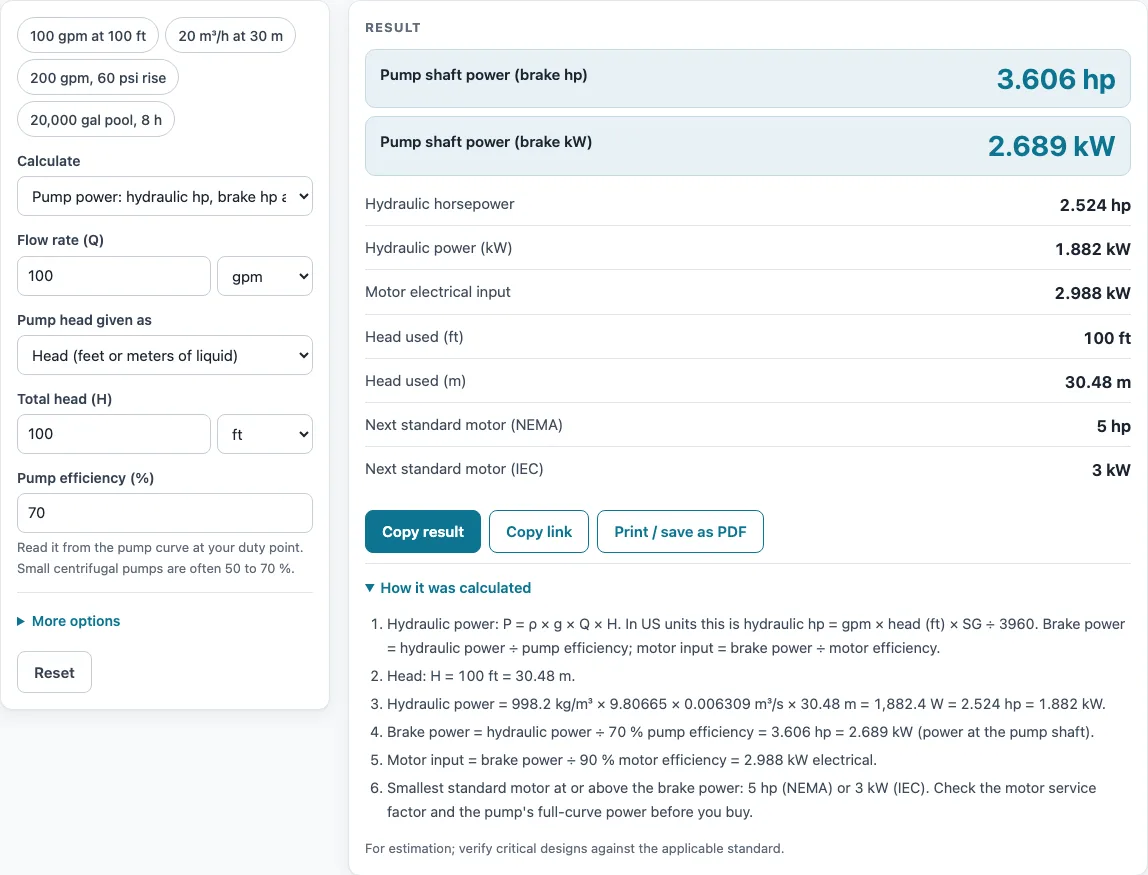
- Review the results: brake hp and kW, hydraulic hp and kW, motor electrical input in kW, the head used, and the next standard motor at or above the brake power. Any input outside the usual range triggers a warning.
- For a pool, change Calculate to Pool pump flow rate (turnover), then enter the pool volume in gal, L or m3 and the turnover time in hours.
Beneath the result, “How it was calculated” lays out the formula, the values used and the answer with units. Copy link saves all your inputs into the page address, Print / save as PDF produces a dated record, and Reset brings back the starting example.
How do you calculate horsepower of a pump?
First find the hydraulic power, which is the power delivered to the water. In US units, hydraulic hp = gpm × head (ft) × SG / 3960. Then divide by the pump efficiency to get brake power, the power the motor must deliver to the pump shaft. Divide brake power by the motor efficiency to get the electrical input.
For 100 gpm at 100 ft with a 70 percent pump, the hydraulic power is 2.524 hp. The brake power is 2.524 / 0.70 = 3.606 hp, which is 2.689 kW. That makes the motor electrical input about 2.988 kW, so the next standard motor is 5 hp (NEMA) or 3 kW (IEC).
How do you calculate hydraulic horsepower?
Hydraulic horsepower is flow multiplied by head and specific gravity, divided by 3960 when flow is in gpm and head is in ft. In SI units, hydraulic power is P = ρ × g × Q × H, where ρ is the density in kg/m3, g is 9.80665 m/s2, Q is the flow in m3/s and H is the head in m. The calculator uses a density of SG × 998.2 kg/m3.
Use head in the same system as the flow. The calculator converts units for you, but if you work by hand, mixing gpm with metres will give the wrong answer.
How is the head of a pump found?
Head is the height the pump must add to the fluid, and it is often the largest input. If you know a pressure rise, convert it with head = P / (ρ × g), which is about psi × 2.31 / SG ft for water. If you have a system, build total dynamic head: static lift + friction loss + the discharge-minus-suction pressure difference.
For 50 gpm with 20 ft of static lift, 10 ft of friction loss and a 10 psi pressure difference, the total dynamic head is 20 + 10 + 23.1 = 53.11 ft. A total head of zero or less is rejected as an error.
How is pool pump flow rate calculated?
Required flow = pool volume in gallons / (turnover time in hours × 60). For a 20,000 gal pool turned over in 8 hours, the flow is 20,000 / (8 × 60) = 41.67 gpm, or 9.464 m3/h. The tool warns for turnover times outside 1 to 24 hours.
This flow is needed at the pump’s real operating head, so the flow you get from a pump curve at that head is what counts. Pool flow and pump horsepower are separate steps: find the flow first, then use it as the input for the horsepower calculation.
Sources
- Hydraulic power P = ρ g Q H and hp = gpm × ft × SG ÷ 3960 (Hydraulic Institute; White, Fluid Mechanics)
- 1 hp = 745.69987 W (550 ft·lbf/s)
- Standard motor sizes: NEMA hp series as listed in US DOE 10 CFR 431.25 and 431.446; IEC kW series as listed in IEC 60034-30-1 (ABB technical note)
Results are for estimation; verify critical designs against the applicable standard.
Worked examples
| Input | Result |
|---|---|
| Q = 100 gpm, H = 100 ft, pump 70 % | 3.606 hp brake (2.689 kW), 5 hp motor |
| Q = 20 m³/h, H = 30 m, pump 65 % | 3.366 hp brake (2.51 kW), 5 hp motor |
| Q = 200 gpm, P = 60 psi, pump 75 % | 9.333 hp brake (6.96 kW), 10 hp motor |
| Q = 50 gpm, TDH 53.11 ft, pump 70 % | 0.9576 hp brake (0.7141 kW), 1 hp motor |
| 20000 gal, 8 h turnover | 41.67 gpm (9.464 m³/h) |
Calculated by the tool above with these values.
Frequently asked questions
Can I use the results in commercial projects or client reports?
Yes. You can use the results in commercial work, including quotes, design notes, reports and client projects, without attribution. Results are estimates, so verify critical designs against the applicable standard, since the tool does not certify compliance with any code.
Is the calculator free, and is anything I type uploaded?
The calculator is free and needs no account or sign-up. All calculations run in your browser, and nothing you type is uploaded.
Can I print or share a calculation?
Yes. Print / save as PDF prints a one-page record with your inputs, results, calculation steps and the date. Copy link copies a page address that stores every input, so the same calculation reopens later or can be sent to a colleague. Copy result copies just the result lines with a link.
How do I choose pump efficiency and motor efficiency?
Use the efficiency from the pump curve at your duty point, since the 70 percent default is only a starting value. The motor efficiency default is 90 percent. The tool warns if pump efficiency is above 95 or below 20 percent, or motor efficiency is above 98 or below 50 percent, and rejects anything over 100 percent.
Related tools
- PVC Pipe Sizing Calculator and Chart: Pick the pipe diameter here before working out head loss and pump power.
- Compressed Air Pipe Sizing Calculator: Good for lines that move compressed air instead of water.
- Cv Calculator (Valve Flow Coefficient): Finds the flow coefficient of a valve sitting in the same system as the pump.
- Flow Rate Calculator: Converts between flow rate and velocity once you know the pipe dimensions.
- Gas Pipe Sizing Calculator (Natural Gas and Propane): Suited to lines carrying gas, not liquid.
- GPM Calculator (Gallons per Minute): Turns a volume and time into gallons per minute before you enter the flow.
- Hazen Williams Formula Calculator: Estimates friction loss, the figure that feeds total dynamic head.
- All pipe, pump and valve calculators: Lists every calculator on the site for browsing.