PSI to Feet of Head Calculator
Convert pressure in psi to feet of head, or feet of head to psi, for water or any liquid, and find the pressure at the bottom of a tank.
The psi to feet of head converter turns a pressure in psi into the equivalent height of a liquid column in feet of head, and it also converts head back into pressure. It works for water, seawater, or any liquid you set by specific gravity or density. The calculator runs in your browser, is free, and needs no account or sign-up.
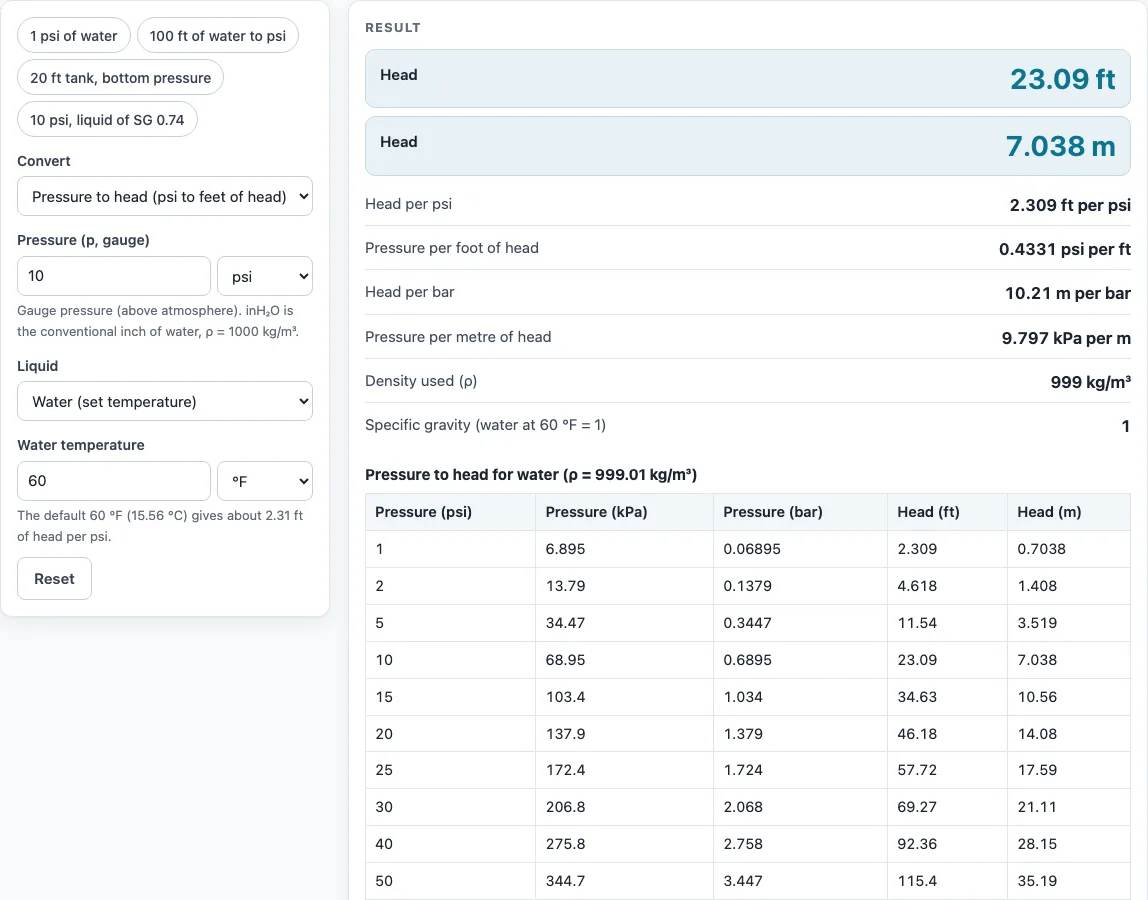
By default it treats the liquid as water at 60 °F, where 1 psi equals 2.309 ft of head. It uses the formula h = p ÷ (ρ·g) with standard gravity, so every result shows the density used and the conversion factors for your chosen liquid. Three modes cover pressure to head, head to pressure, and tank or column height to bottom pressure.
How to use the psi to feet of head converter
- Under Convert, choose Pressure to head to convert psi into feet of head, Head to pressure to convert feet head to psi, or Tank or column height to bottom pressure.
- Type the pressure and select psi from its unit menu. Each quantity has its own menu, so you can mix metric and US customary units.
- Choose the liquid. Keep water and set its temperature, pick seawater, or enter a specific gravity (choose whether the reference is 60 °F water or 4 °C water) or a density.
- Read the result in feet and metres of head, along with the ft per psi and psi per ft factors for your liquid.
- Open How it was calculated under the result to see the formula, the values substituted, and the answer with units.
Warnings appear if the specific gravity is outside 0.5 to 2, if the pressure is negative (a vacuum, or suction lift), or if the head is negative. Preset buttons above the form load typical cases, More options holds the less common inputs, and Reset restores the starting example.
Use Copy result to copy the result lines with a link, or Copy link to copy the page address. Every input is saved in the address, so the same calculation reopens later or can be sent to a colleague. Print / save as PDF creates a one-page record with the inputs, results, calculation steps and date.
How to calculate head pressure
Head pressure is the height of a liquid column that produces a given pressure, and you calculate it with h = p ÷ (ρ·g). Here p is the pressure in pascals, ρ is the liquid density in kg/m³, and g is 9.80665 m/s². Denser liquids give less head for the same pressure.
To calculate it by hand:
- Express the pressure in pascals. For example, 10 psi is 68,948 Pa.
- Look up the liquid’s density. At 60 °F, water uses 999.0 kg/m³ from the Kell (1975) formula in the calculator, not a rounded 62.4 lb/ft³.
- Divide pressure by ρ·g, then convert metres to feet if needed.
For water, 10 psi gives 23.1 ft of head. A liquid with specific gravity 0.74 gives 31.2 ft at the same 10 psi. Pipe size makes no difference: head depends only on pressure and density.
Pressures in the calculator are gauge pressures. To get absolute pressure, add atmospheric pressure.
How many feet of head is 1 psi?
At 60 °F, water gives 1 psi = 2.309 ft of head, or 0.7038 m. Reversed, 1 ft of head equals 0.4331 psi. Those computed figures agree with the familiar 2.31 and 0.433 values in pump references.
For another liquid, divide by its specific gravity. For a liquid with SG 0.74, 1 psi equals 2.31 ÷ 0.74 = 3.12 ft of head. Warmer water is a little less dense than cold, so it yields slightly more feet of head per psi.
Sources
- h = p / (ρ g), standard gravity g = 9.80665 m/s² and the psi, bar and kPa factors: NIST SP 811
- Water density vs temperature: Kell (1975), checked against the NIST Chemistry WebBook
- The familiar 2.31 ft per psi (head = 2.31 × psi / SG), for comparison: Engineering ToolBox, pump head and pressure
Results are for estimation; verify critical designs against the applicable standard.
Worked examples
| Input | Result |
|---|---|
| 1 psi | Head = 2.309 ft (0.7038 m) |
| 100 ft | Pressure = 43.31 psi (298.6 kPa) |
| 4 bar | Head = 134.1 ft (40.86 m) |
| 12 m + 50 kPa | Pressure = 24.3 psi (167.6 kPa) |
| 10 psi | Head = 31.2 ft (9.51 m) |
Calculated by the tool above with these values.
Frequently asked questions
How do I convert feet of head to psi?
Multiply the head in feet by the liquid’s specific gravity, then divide by about 2.31 (2.309 for water at 60 °F). For water, 100 ft of head is 43.31 psi, and the calculator’s head-to-pressure mode does this for you.
How do I convert psi to feet of head for a liquid that is not water?
Enter the liquid’s specific gravity or density in the liquid menu, then convert. Without the tool, divide 2.31 × psi by the specific gravity. For example, 10 psi on a liquid with SG 0.74 is 31.2 ft of head.
What is the pressure at the bottom of a 20 ft water tank?
For an open tank, the pressure at the bottom is about 8.66 psi. Use the tank or column mode for this calculation. If the surface has a pressure above atmospheric, that pressure is added to the liquid column.
How much head pressure does water have per foot?
Water at 60 °F has about 0.433 psi per foot of head. Each foot of water column adds that much pressure at the bottom.
Can I use the results in commercial projects or client reports?
Yes. Results may be used in commercial work, including quotes, design notes, reports and client projects, without attribution. The result is for estimation, so check critical designs against the applicable standard. The tool does not certify compliance with any code.
Is the calculator free, and is anything I type uploaded?
The calculator is free, and there is no account or sign-up. Everything is calculated in your browser, and nothing you type is uploaded.
Related tools
- Pump horsepower calculator: gives the power a pump needs once you know its flow and head.
- NPSH calculator: checks net positive suction head for a pump installation.
- Pressure drop calculator: finds the friction loss along a pipe run.
- GPM calculator: converts flow rates expressed in gallons per minute.
- Pipe sizing calculator: helps you pick a pipe diameter for a set flow.
- All pipe, pump and valve calculators: lists every tool on the site so you can browse them.