Pressure Drop Calculator (Pipe Friction Loss)
Enter the flow, the pipe and its length to get the pressure drop and head loss, with the Darcy friction factor, Reynolds number and a friction loss table.
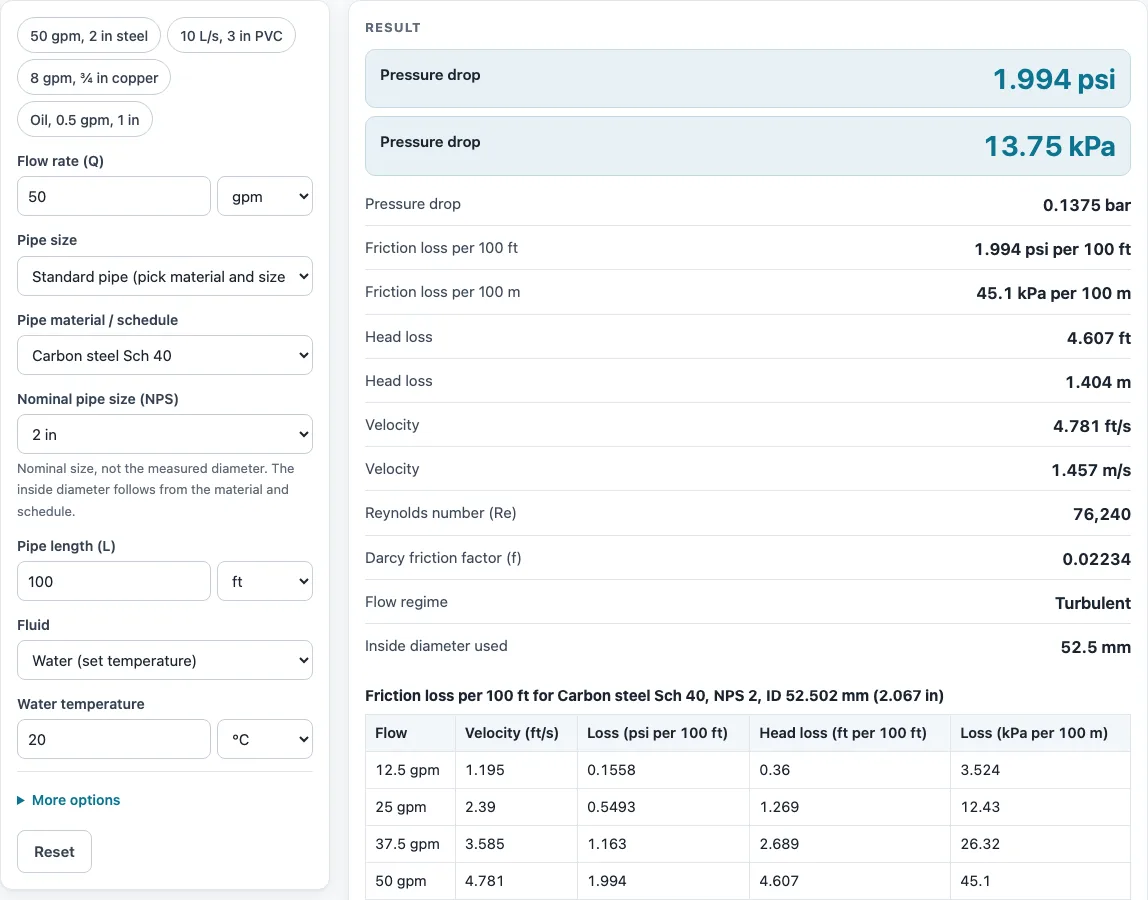
How to use the Pressure Drop Calculator
- Enter the flow rate and choose its unit from the menu, such as gpm, L/s or m³/h.
- Enter the pipe length and choose ft, m, in or mm.
- Choose the pipe. Pick a standard material (carbon steel, stainless steel, PVC, copper, PEX or HDPE) and a nominal size, or enter a custom inside diameter in in, mm, cm, m or ft.
- Set the fluid. For water, enter the temperature (0 to 100 °C, or the same range in °F). For seawater, select it. For any other liquid, enter its density and dynamic viscosity.
- If you need them, open More options to add pipe roughness, elevation gain Δz (positive uphill, negative downhill) or the sum of fitting loss coefficients ΣK.
- Read the result: total pressure drop, friction loss per 100 ft or 100 m, head loss, velocity, Reynolds number, friction factor and flow regime. Check any warnings shown.
- Open “How it was calculated” under the result to see the formula, the values substituted and the answer with units.
Each quantity has its own unit menu, so you can mix metric and US customary units. Preset buttons above the form load typical cases, and Reset restores the starting example.
Copy link stores every input in the page address, and Print / save as PDF gives a dated one-page record.
How is pressure drop in a pipe calculated?
This pipe pressure drop and friction loss calculator uses the Darcy-Weisbach equation. The pressure drop in the straight pipe is Δp = f·(L ÷ D)·ρ·v² ÷ 2, where f is the Darcy friction factor, L is the pipe length, D is the inside diameter, ρ is the fluid density and v is the velocity. Velocity comes from v = Q ÷ A, where A = π ÷ 4 × D², and the Reynolds number is Re = ρ·v·D ÷ μ, with μ the dynamic viscosity.
The friction factor depends on the flow regime. Below Re 2300 the flow is laminar and f = 64 ÷ Re. Above that, the Colebrook-White equation is solved iteratively, and the Swamee-Jain approximation is shown as a check in the steps. Pipe roughness sets the turbulent friction factor. If you leave it empty, the default is 0.045 mm for commercial steel, 0.0015 mm for copper, PVC, PEX and HDPE. Between Re 2300 and 4000 the flow is labelled transitional (unstable), the higher turbulent value is used, and the result is approximate.
Fittings and elevation are added to the pipe figure. Fittings add ΣK·ρ·v² ÷ 2, and elevation adds ρ·g·Δz. Head loss is h = f·(L ÷ D)·v² ÷ 2g, with g = 9.80665 m/s².
For example, 50 gpm of 20 °C water through 100 ft of 2 in Sch 40 carbon steel gives v = 4.781 ft/s, Re = 76,240, f = 0.02234 and a pressure drop of 1.994 psi (13.75 kPa), which is a head loss of 1.404 m.
Pipe dimensions come from ASME B36.10M/B36.19M, ASTM D1785, B88, F876 and the DR 11 rule (wall = OD ÷ 11). Plastic pipe walls are the standard minimum, so the real bore is slightly larger.
Sources
- Darcy-Weisbach, Colebrook-White and Swamee-Jain (1976) (White, Fluid Mechanics; Crane TP-410)
- Roughness: Moody (1944); fitting loss K = 30 fT for a standard 90° elbow: Crane TP-410
- Water properties: Kell (1975) and IAPWS 2008, checked against the NIST Chemistry WebBook
- Pipe dimensions: see the Pipe Schedule Chart sources
Results are for estimation; verify critical designs against the applicable standard.
Worked examples
| Input | Result |
|---|---|
| 50 gpm, Carbon steel Sch 40 NPS 2, 100 ft | Δp = 1.994 psi (13.75 kPa), velocity 4.78 ft/s |
| 10 L/s, PVC Schedule 40 NPS 3, 200 m | Δp = 21.31 psi (146.9 kPa), velocity 6.88 ft/s |
| 20 gpm, Copper tube Type L NPS 1-1/2, 150 ft | Δp = 1.922 psi (13.25 kPa), velocity 3.61 ft/s |
| 0.5 gpm, Carbon steel Sch 40 NPS 1, 50 ft | Δp = 0.5637 psi (3.886 kPa), velocity 0.186 ft/s |
Calculated by the tool above with these values.
Frequently asked questions
Can I use the results in commercial projects or client reports?
Yes. Results may be used in commercial work, including quotes, design notes, reports and client projects, without attribution. The figures are estimates for design checking, and the tool does not certify compliance with any code.
Is the calculator free, and is anything I type uploaded?
Yes, it is free, every calculation runs in your browser, nothing you type is uploaded, and there is no account or sign-up.
Does this calculator work for air ducts?
No. It covers liquids flowing through full circular pipes only, not air ducts or compressible gas. For compressed air in pipes, use the compressed air pipe sizing calculator.
Can I calculate seawater or oil?
Yes. Seawater is built in at 1025 kg/m³ and 1.08 mPa·s. For other liquids such as oil, choose the custom fluid option and enter density and dynamic viscosity in cP, mPa·s, Pa·s or P. Oil at low flow is often laminar, and the calculator then uses f = 64 ÷ Re.
What is the difference between head loss and pressure drop?
Both describe the same friction loss in different units. Pressure drop is shown in psi, kPa and bar, while head loss expresses it as a height of liquid in ft and m. The head loss is calculated as h = f·(L ÷ D)·v² ÷ 2g.
How do I include fittings and a height change?
Open More options and enter the sum of fitting loss coefficients ΣK, plus an elevation gain Δz (positive uphill, negative downhill). The result then shows the part of the drop due to fittings and elevation separately from the straight pipe.
What do the warnings mean?
Warnings flag conditions to review before you rely on the figure. They appear for velocity above 3 m/s (10 ft/s), laminar or transitional flow, relative roughness above 0.05, a negative elevation or total, and a pipe shorter than 20 diameters with no fittings.
Related tools
- PVC Pipe Sizing Calculator and Chart - Use it to choose a pipe size before checking the pressure drop.
- Compressed Air Pipe Sizing Calculator - Use it for compressed air, which this calculator does not cover.
- Cv Calculator (Valve Flow Coefficient) - Use it to size or compare valves by their flow coefficient.
- Flow Rate Calculator - Use it to convert between flow units or find a flow rate before entering it here.
- Gas Pipe Sizing Calculator (Natural Gas and Propane) - Use it for natural gas or propane lines.
- GPM Calculator (Gallons per Minute) - Use it to work out gallons per minute from other flow units.
- Hazen Williams Formula Calculator - Use it for a second check of friction loss in water pipes using the Hazen-Williams formula.
- All pipe, pump and valve calculators - Use it to browse every calculator on the site.