Pipe Velocity Calculator
Enter the flow rate and the pipe size or inside diameter to get the flow velocity, or switch to find the flow rate from a velocity.
The Pipe Velocity Calculator finds how fast a fluid moves through a pipe. Enter a flow rate and a pipe size, and it returns the velocity in ft/s and m/s. It can also work backwards, giving the flow rate for a velocity you choose. It works for full circular pipes, using standard steel, stainless, PVC, copper, PEX and HDPE sizes or a custom inside diameter. This pipe line velocity calculator suits water and other fluids in full pipes.
The calculator runs in your browser, is free, and needs no account or sign-up. Results update as you type, and each one comes with the formula and the values used, so you can check the working. Use it for quick design estimates, pump and piping checks, or confirming that a line stays within a sensible speed range.
How to use the Pipe Velocity Calculator
- Open the Solve for menu and choose velocity from flow rate, or flow rate from velocity.
- Enter the known value and pick its unit from that quantity’s unit menu. Flow units include gpm, L/s, m³/h and MGD. Velocity units include ft/s, m/s, ft/min and m/min.
- Leave Pipe size on Standard pipe and choose the material and schedule, such as carbon steel, stainless, PVC, copper, PEX or HDPE.
- Choose the nominal pipe size (NPS). For a non-standard pipe, set Pipe size to Custom inside diameter and enter it in in, mm, cm, m or ft.
- Read the velocity (or flow rate) under the form. The result updates as you type.
- Open How it was calculated to see the formula, the values substituted and the answer with units.
- Check any warning shown under the result, for example a velocity above 3 m/s or below 0.1 m/s.
- Open More options for less common inputs, such as the water temperature.
Preset buttons above the form load four typical cases, and Reset restores the starting example. Use Copy result to copy the result lines with a link, Copy link to share every input, or Print / save as PDF to get a one-page record.
What is the velocity through pipe formula?
The velocity through a pipe is the flow rate divided by the flow area: v = Q ÷ A. Here v is the mean velocity, Q is the volumetric flow rate, and A is the cross-sectional area of the bore. The formula assumes the pipe is flowing full, and the velocity is averaged across the whole cross-section.
For a full circular pipe, the flow area is A = π ÷ 4 × ID², where ID is the inside diameter. The formula can also run in reverse as Q = v × A. The inside diameter must be the actual bore, not the nominal size. A 2 in Sch 40 steel pipe, for example, has an inside diameter of 2.067 in (52.50 mm).
In US customary units there is a shortcut: v (ft/s) = 0.4085 × Q (gpm) ÷ d² (in). It is the same equation written in those units, and the calculator gives the same answer.
How do you calculate water velocity in a pipe?
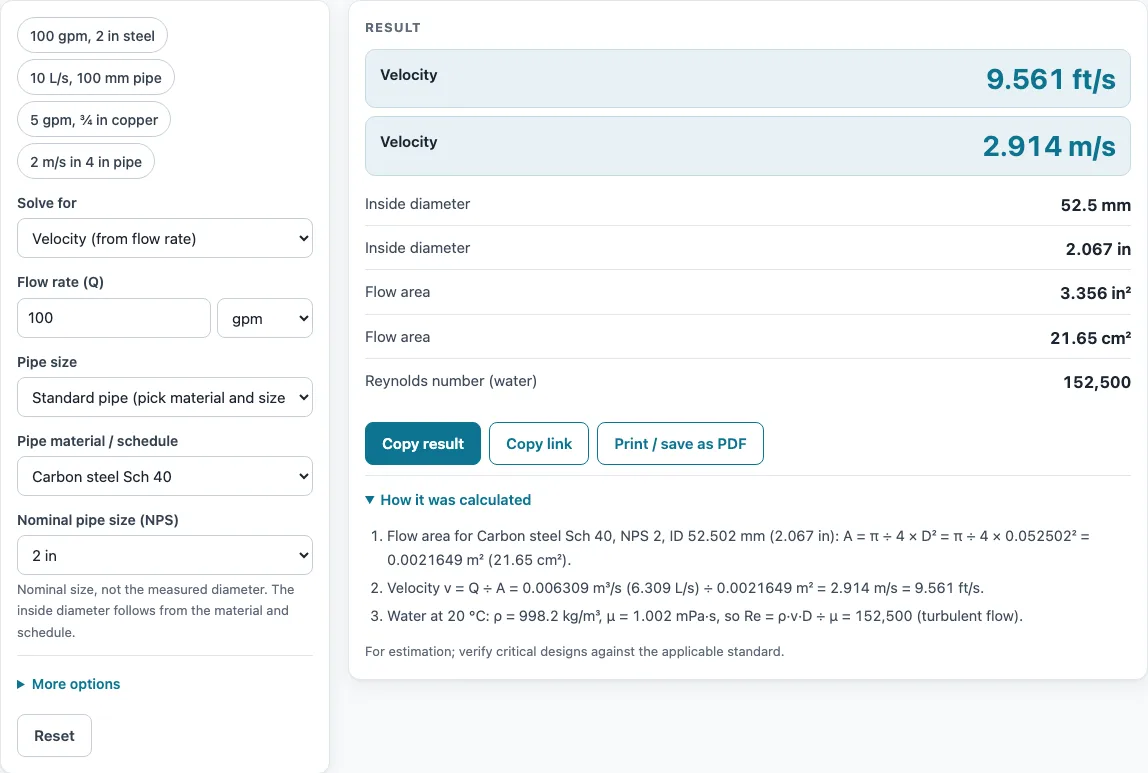
Start with the flow rate and the inside diameter, convert them to units that match the formula, find the area, and divide. For 100 gpm through 2 in Sch 40 carbon steel, the area is about 3.36 in², and 100 gpm ÷ 3.36 in² gives the velocity. The shortcut gives the same result: 0.4085 × 100 ÷ 2.067² = 9.561 ft/s, which is 2.914 m/s.
A metric check works the same way. Water at 10 L/s through a 100 mm inside diameter pipe moves at 1.273 m/s, or 4.177 ft/s.
Two warnings help you judge the answer. A velocity above 3 m/s (about 10 ft/s) raises the risk of erosion, noise and water hammer. A velocity below 0.1 m/s lets solids settle and makes flow hard to measure. These are general guides, not code limits. The calculator also gives the Reynolds number, Re = ρ·v·D ÷ μ. A value between 2300 and 4000 means the flow is transitional, which is a different regime from fully turbulent flow.
Sources
- Continuity equation v = Q/A (White, Fluid Mechanics, ch. 3) and the US form 0.4085 Q/d² (Crane TP-410)
- Pipe dimensions: see the Pipe Schedule Chart sources; unit factors from NIST SP 811
- Water viscosity for Reynolds number: NIST Chemistry WebBook
Results are for estimation; verify critical designs against the applicable standard.
Worked examples
| Input | Result |
|---|---|
| 100 gpm, Carbon steel Sch 40 NPS 2 | v = 9.561 ft/s (2.914 m/s) |
| 10 L/s, ID 100 mm | v = 4.177 ft/s (1.273 m/s) |
| 5 gpm, Copper tube Type L NPS 3/4 | v = 3.315 ft/s (1.01 m/s) |
| 2 m/s, Carbon steel Sch 40 NPS 4 | Q = 260.4 gpm (16.43 L/s) |
Calculated by the tool above with these values.
Frequently asked questions
Can I use the results in commercial projects or client reports?
Yes. Results may be used in commercial work, including quotes, design notes, reports and client projects, without attribution. Results are for estimation, so verify critical designs against the applicable standard. The tool does not certify compliance with any code.
Is the calculator free, and is anything I type uploaded?
The calculator is free and needs no account or sign-up. Everything is calculated in your browser, and nothing you type is uploaded.
Can I print or share a calculation?
Yes. Print / save as PDF creates a one-page record with the inputs, results, calculation steps and the date. Copy link gives an address that stores every input, so the same calculation reopens later or can be sent to a colleague.
Can I mix metric and US customary units?
Yes. Each quantity has its own unit menu, so you can enter flow in L/s and the pipe size in inches. The calculator converts the units before it calculates.
Does water temperature change the velocity?
No. Temperature affects only the Reynolds number, which uses water at 20 °C by default. You can change it in More options (0 to 100 °C, or the same range in °F), but the velocity stays the same.
Can I use it for a partly full pipe or a gravity drain?
No. The result is a mean velocity that assumes the pipe is flowing full. For partly full or gravity pipes, use the Manning mode of the pipe flow calculator.
Related tools
- Compressed Air Pipe Sizing Calculator: use it to size air lines for a given flow and pressure drop.
- Gas Pipe Sizing Calculator (Natural Gas and Propane): use it to size gas lines for a required load.
- Pipe Flow Calculator: use it to work through other flow quantities in a pipe.
- Pipe Schedule Chart and Pipe Size Lookup: use it to check wall thickness and inside diameters before you calculate.
- Steam Pipe Sizing Calculator: use it when the fluid in the line is steam.
- PVC Pipe Sizing Calculator and Chart: use it to find a suitable pipe size for a flow rate.
- Cv Calculator (Valve Flow Coefficient): use it to relate flow to pressure drop across a valve.
- All pipe, pump and valve calculators: use it to browse the full set of tools on this site.