Pipe Schedule Chart and Pipe Size Lookup
Look up one pipe size and schedule for its outside diameter, wall, inside diameter, flow area and weight, or print the full chart.
The Pipe Schedule Chart gives the outside diameter, wall thickness and inside diameter of a pipe, based on its nominal pipe size (NPS) and schedule. You can look up one size, or print a full chart for carbon steel, stainless steel or PVC. It runs in your browser, it is free, and there is no account or sign-up.
Use it when you need a quick pipe schedule size chart, such as checking a Schedule 40 pipe chart before ordering, comparing an SS pipe schedule chart with a carbon steel one, or reading a PVC pipe schedule chart for a plumbing job. The results update as you type, so you can change a size or schedule and see the new values straight away.
How to use the Pipe Schedule Chart
- Under What do you need?, choose Look up one pipe or Full chart (all sizes).
- For a single pipe, enter the NPS (from 1/8 to 24) and pick a schedule from the list, such as 40, 80, 10S or PVC Sch 40.
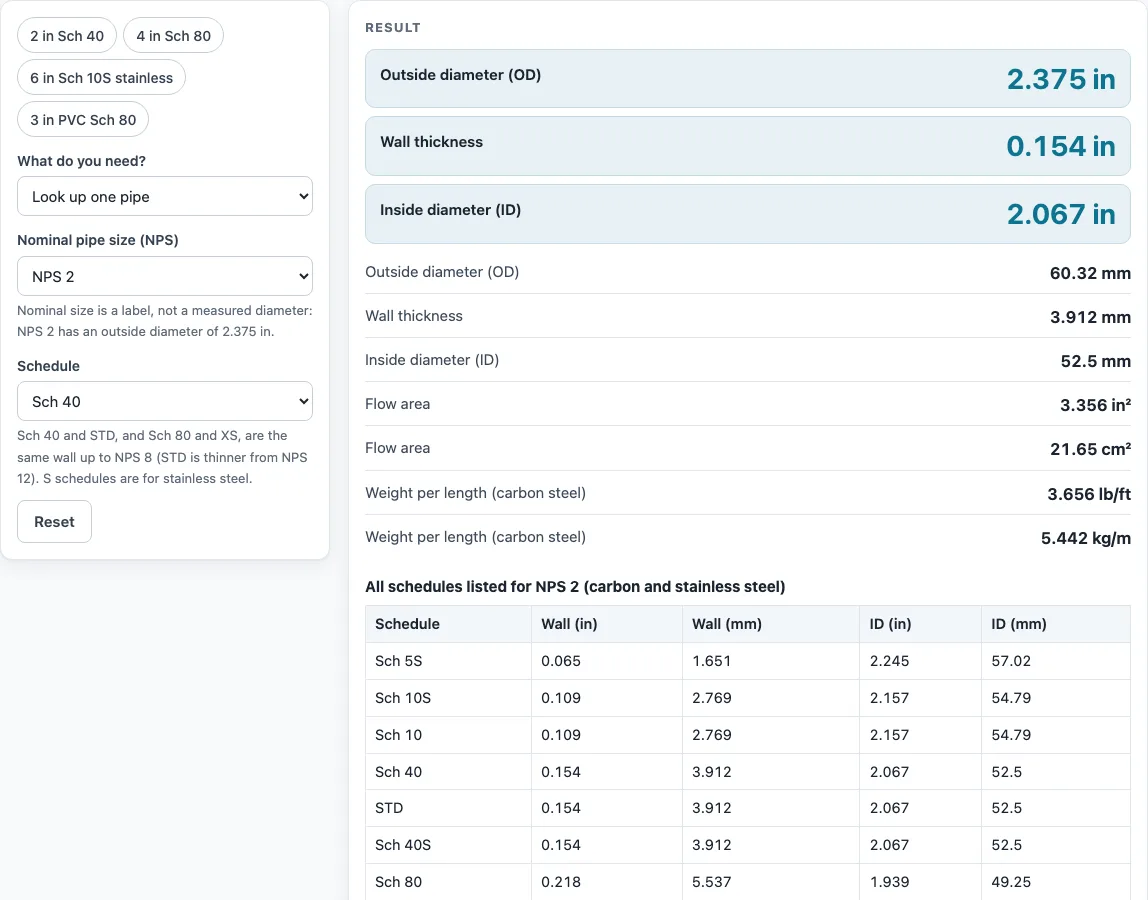
- Read the result: outside diameter, wall thickness and inside diameter, in inches and millimeters. Flow area and, for steel schedules, plain-end weight per length are also shown.
- Check the small table below the result, which lists every schedule made in that NPS with its wall thickness and inside diameter.
- For a full chart, open the Chart select and choose carbon steel, stainless steel or PVC. Read the wall thickness table and the inside diameter table. A dash means that schedule is not made in that size.
- Open How it was calculated under the result to see the formula, the values used and the answer.
Start from a preset button if you want a typical case, and select Reset to return to the starting example. Copy result copies the result lines with a link, and Copy link copies the page address with your inputs saved. Print / save as PDF prints a one-page record of the inputs, results, steps and date.
How do you read a pipe schedule chart?
Read across from the nominal pipe size to the schedule column. Nominal size is a label, not a measured size. NPS 2 pipe has an outside diameter of 2.375 in for every schedule, and only the wall thickness changes. The inside diameter is found by subtracting twice the wall from the outside diameter:
ID = OD − 2 × wall
For NPS 2, Schedule 40, the wall is 0.154 in, so ID = 2.375 − 2 × 0.154 = 2.067 in. The flow area is π ÷ 4 × ID², which gives 3.356 in².
Carbon steel dimensions follow ASME B36.10M, stainless steel (5S, 10S, 40S and 80S) follows ASME B36.19M, and PVC Sch 40 and 80 follow ASTM D1785 for NPS 1/2 to 12. Steel weight uses w = 10.69 × (OD − t) × t lb/ft, with OD and t in inches. For the same NPS 2 Schedule 40 pipe, that gives 3.656 lb/ft. Stainless steel is roughly 2 % heavier because it is denser. PVC weight is not shown, and the PVC wall is the standard minimum, so the real inside diameter is slightly larger.
STD, XS and XXS are older weight-class names. STD equals Sch 40 up to NPS 10 but has a 0.375 in wall from NPS 12, and XS equals Sch 80 up to NPS 8.
What is the difference between Schedule 40 and Schedule 80 pipe?
Both have the same outside diameter for a given NPS, so they fit the same fittings and clamps. Schedule 80 has a thicker wall, so its inside diameter and flow area are smaller and it weighs more per foot. For NPS 2, Schedule 40 has a 0.154 in wall and a 2.067 in ID, while Schedule 80 has a 0.218 in wall and a 1.939 in ID. The thicker wall gives a higher pressure rating, but this chart lists dimensions only, not pressure ratings.
Sources
- Steel pipe: ASME B36.10M and B36.19M (per Project Materials and Wikipedia “Nominal Pipe Size” tables based on the standards)
- PVC Schedule 40 and 80: ASTM D1785 (Charlotte Pipe catalog)
- Steel weight formula: ASME B36.10M note, w = 10.69 (OD − t) t lb/ft
Results are for estimation; verify critical designs against the applicable standard.
Worked examples
| Input | Result |
|---|---|
| NPS 2, Sch 40 | OD 2.375 in, wall 0.154 in (3.91 mm), ID 2.067 in |
| NPS 4, Sch 80 | OD 4.500 in, wall 0.337 in (8.56 mm), ID 3.826 in |
| NPS 6, Sch 10S | OD 6.625 in, wall 0.134 in (3.4 mm), ID 6.357 in |
| NPS 3, PVC Sch 80 | OD 3.500 in, wall 0.300 in (7.62 mm), ID 2.900 in |
Calculated by the tool above with these values.
Frequently asked questions
Is the calculator free, and is anything I type uploaded?
Yes, the calculator is free, and there is no account or sign-up. Everything is calculated in your browser, and nothing you type is uploaded.
Can I use the results in commercial projects or client reports?
Yes. Results may be used in quotes, design notes, reports and client work without attribution. They are estimates, so check critical designs against the applicable standard.
Can I print or share a calculation?
Yes. Print / save as PDF gives a one-page record with the inputs, results, steps and date. Copy link stores your inputs in the page address so the same calculation reopens later or can be sent to a colleague.
What does a dash mean in the full chart?
A dash means that schedule is not made in that nominal size. For example, a schedule may exist for NPS 2 but not for NPS 1/8.
What happens if I pick a schedule that does not exist for a size?
The tool shows an error and lists the sizes made for that schedule. Sch 160 in NPS 1/8 is an example of a combination that does not exist.
Is STD the same as Schedule 40?
Up to NPS 10, yes: STD and Schedule 40 have the same wall. From NPS 12 up, STD stays at a 0.375 in wall while Schedule 40 gets thicker, so check which one you need.
Related tools
- Compressed Air Pipe Sizing Calculator: use it to choose a pipe size for compressed air lines.
- Gas Pipe Sizing Calculator (Natural Gas and Propane): use it to size gas supply pipes.
- Pipe Flow Calculator: use it to work out flow through a pipe of a given size.
- Pipe Velocity Calculator: use it to check fluid speed in a pipe.
- Steam Pipe Sizing Calculator: use it to size steam lines.
- PVC Pipe Sizing Calculator and Chart: use it to size runs in PVC, copper, PEX or steel.
- Cv Calculator (Valve Flow Coefficient): use it to find the flow coefficient of a valve.
- All pipe, pump and valve calculators: use it to browse every calculator on the site.