NPSH Calculator (Available NPSH)
Enter the liquid temperature, the suction tank conditions, the static head and the suction line loss to get NPSH available and your margin over the pump's NPSHr.
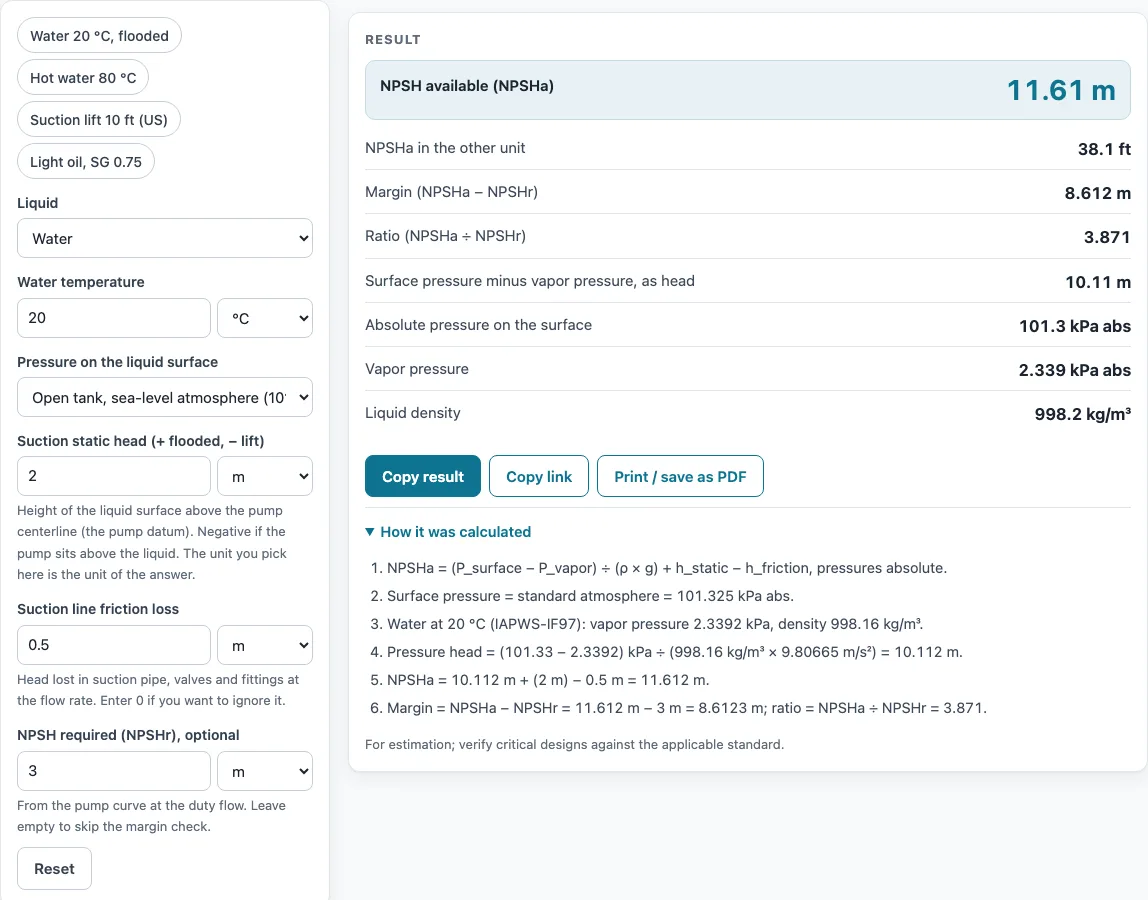
How to use the NPSH Calculator
- Pick a preset above the form if one fits: water 20 °C flooded, hot water 80 °C, suction lift 10 ft in US units, or light oil SG 0.75. Otherwise, start from the example already loaded.
- Set the surface pressure. Choose a sea-level open tank, an open tank at a site elevation, or a closed-tank pressure in barg, kPag, MPag, psig, bar abs, kPa abs or psia.
- Enter the liquid. For water, enter the temperature in °C or °F (0 to 200 °C). For any other liquid, enter the absolute vapour pressure at pumping temperature and the specific gravity.
- Enter the suction static head. Use a positive value for a flooded suction and a negative value for a suction lift. Pick m or ft; that unit is the unit of the answer.
- Enter the suction friction loss in m or ft. It is subtracted, and it cannot be negative.
- Optional: enter NPSHr from the pump curve at the duty flow to see the margin and the ratio.
- Read the result. It updates as you type. Check any warnings, then open “How it was calculated” to see the formula, the values substituted and the answer with units.
Each quantity has its own unit menu, so you can mix metric and US customary units. Open “More options” for the less common inputs, and use “Reset” to return to the starting example. “Copy link” stores every input in the page address, and “Print / save as PDF” gives a dated record.
What does NPSH available mean?
NPSH available is the absolute pressure at the pump suction minus the liquid’s vapour pressure, expressed as a head of liquid in metres or feet. It shows how much pressure headroom the liquid has before it starts to boil inside the pump. When that headroom is too small, vapour bubbles form and collapse inside the pump, a process called cavitation.
How is NPSH available calculated?
The tool applies NPSHa = (surface pressure absolute − vapor pressure) / (density × g) + static head − suction friction loss, with g = 9.80665 m/s². Pressure head from the surface comes first in that expression. Static head is added when the liquid surface sits above the pump and subtracted when the pump lifts the liquid. Suction pipe friction loss is always subtracted. Water’s density and vapour pressure come from the IAPWS-IF97 formulation, while other liquids use density equal to specific gravity × 999.0 kg/m³.
Why does liquid temperature change NPSH available?
A hotter liquid has a higher vapour pressure, which takes up more of the surface pressure and leaves less pressure head. Take water at 80 °C, flooded 3 m, friction 1 m: NPSHa = 7.657 m. That is about 4.5 m lower than 20 °C water, owing to the higher vapour pressure.
How does suction lift reduce NPSH available?
A suction lift enters as a negative static head, so it cuts NPSHa directly. Atmospheric pressure also drops with elevation, which is why the tool offers site elevation as a surface pressure option. Consider water at 20 °C with a 3 m lift, 0.8 m friction and a site at 5,000 ft (84.31 kPa): NPSHa = 4.574 m. With NPSHr of 4 m, the ratio is 1.143.
What do the NPSH margin and ratio show?
The margin equals NPSHa − NPSHr, and the ratio equals NPSHa / NPSHr. Cavitation is expected when the margin falls below zero or the ratio falls below 1. A ratio of at least 1.1 is widely used as a minimum, with guidance in ANSI/HI 9.6.1. Plenty of specifications ask for more. For water at 20 °C with a 2 m flooded suction and 0.5 m friction, NPSHa is 11.612 m. Against NPSHr of 3 m, the margin comes to 8.612 m and the ratio to 3.87.
Sources
- NPSHa definition: Hydraulic Institute standards and Karassik, Pump Handbook
- Water vapor pressure and density: IAPWS-IF97 (R7-97(2012)), checked against Sonntag-Heinze values
- Standard atmosphere: US Standard Atmosphere 1976 / ICAO Doc 7488
- NPSH margin: ANSI/HI 9.6.1 (guidance only; this tool does not check compliance)
Results are for estimation; verify critical designs against the applicable standard.
Worked examples
| Input | Result |
|---|---|
| 20 °C water, static head 2 m, friction 0.5 m | NPSHa = 11.61 m |
| 80 °C water, static head 3 m, friction 1 m | NPSHa = 7.657 m |
| 68 °F water, static head -10 ft, friction 2 ft | NPSHa = 21.18 ft |
| 20 °C water, static head -3 m, friction 0.8 m | NPSHa = 4.574 m |
| SG 0.75, Pv 60 kPa abs, static head 4 m, friction 0.6 m | NPSHa = 9.024 m |
Calculated by the tool above with these values.
Frequently asked questions
Can I use the results in commercial projects or client reports?
Yes. Results may be used in commercial work such as quotes, design notes, reports and client projects, without attribution. The page states that the result is for estimation, so verify critical designs against the applicable standard. The tool does not certify compliance with any code.
Is the calculator free, and is anything I type uploaded?
Yes, the calculator is free, and there is no account or sign-up. Everything is calculated in your browser, and nothing you type is uploaded.
Can I print or share a calculation?
Yes. “Print / save as PDF” produces a one-page record with the inputs, results, calculation steps and date. “Copy link” copies a page address that stores every input, so the calculation can be reopened later or sent to a colleague.
Does the calculator check my pump against a standard or calculate friction loss?
No. It does not check compliance with any standard, and it does not calculate friction loss. Work out the suction line loss with the pressure drop calculator and enter it here as head.
What does a warning that the ratio is below 1.1 mean?
It means the NPSH available is only slightly above the NPSH required, which leaves little safety margin against cavitation. Review the suction design, for example by reducing friction loss or lift, or by raising the liquid level, and check the requirement in the applicable standard or specification.
Related tools
- PVC Pipe Sizing Calculator and Chart: choose a suction pipe diameter here before you estimate friction loss.
- Compressed Air Pipe Sizing Calculator: for air lines, not liquid suction lines.
- Cv Calculator (Valve Flow Coefficient): checks valve flow coefficients along a suction or control line.
- Flow Rate Calculator: finds the duty flow you need before reading the pump curve.
- Gas Pipe Sizing Calculator (Natural Gas and Propane): the right pick when your job is gas supply pipework.
- GPM Calculator (Gallons per Minute): converts gallons per minute so the flow matches a pump curve.
- Hazen Williams Formula Calculator: estimates water pipe friction loss for the suction friction input.
- All pipe, pump and valve calculators: a full list of every tool in the set.