Mass Flow Rate Formula and Calculator
Apply the mass flow rate formula: density times volumetric flow, or density times area times velocity, with gas density from pressure and temperature.
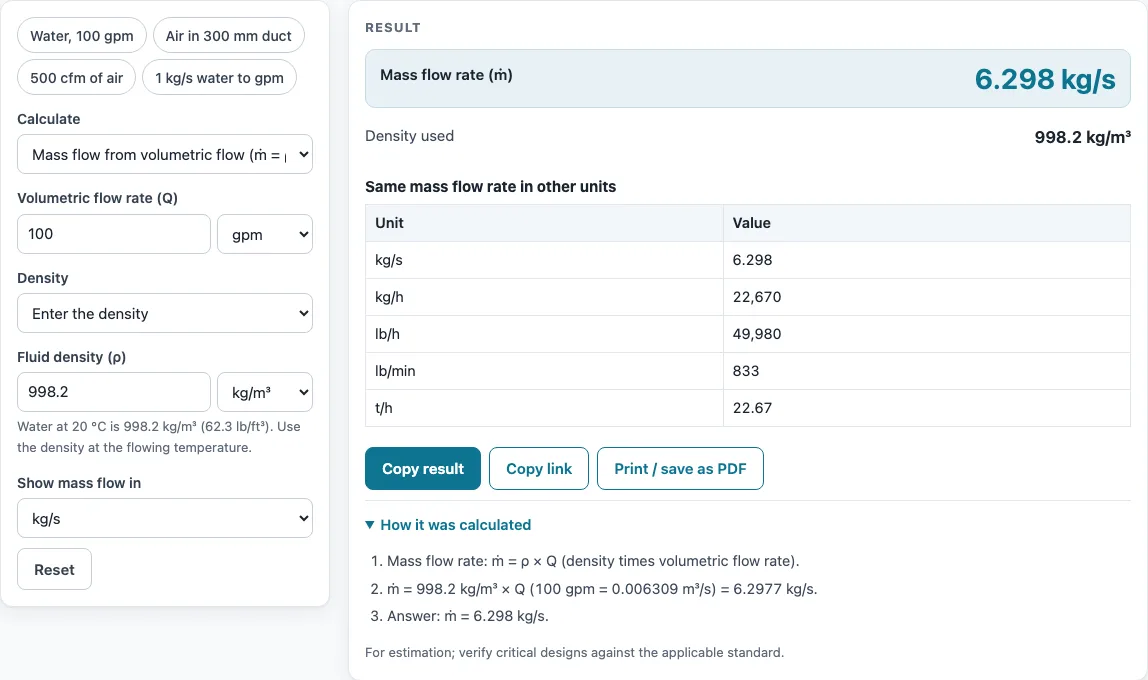
How to use the Mass Flow Rate Calculator
- Under Calculate, choose a mode. The first gives mass flow from density and volumetric flow rate. The second gives mass flow from density, velocity and either a pipe inside diameter or a flow area. The third gives volumetric flow from a mass flow.
- Enter the density. Type it in kg/m³, g/mL, lb/ft³ or lb/gal. The default is 998.2 kg/m³, which is water at 20 °C.
- For a gas, set Density to Calculate for an ideal gas instead. Pick a built-in gas (dry air, N2, O2, CO2, CH4, propane, H2 or He), or enter any molar mass. Then enter the pressure, absolute or gauge, and the temperature in °C, °F or K.
- Enter the flow. Use a volumetric flow in gpm, L/min, L/s, m³/h, cfm, cfs or m³/s, or enter a velocity with a pipe diameter or flow area.
- Set the unit for each quantity in its own menu. You can mix metric and US customary units because the tool converts them before it calculates.
- Read the result. It updates as you type and appears in your chosen unit, with a table of all five mass flow units. Open “How it was calculated” under the result to see the formula and the values used.
Preset buttons above the form load typical cases, and “More options” holds the less common inputs. “Reset” restores the starting example. “Copy link” saves every input in the page address.
What is the mass flow formula?
The mass flow formula is ṁ = ρ × Q, where ṁ (m-dot) is mass flow rate, ρ is density and Q is volumetric flow rate. Mass flow is the mass that passes a point each unit of time, so a denser fluid, or the same fluid at a higher flow, carries more mass each second.
Volumetric flow equals flow area times velocity, so the same idea can be written ṁ = ρ × A × v. Here A is flow area and v is velocity. For a round pipe, A = π/4 × D², where D is the inside diameter. For example, air at 1.2 kg/m³ in a 300 mm duct moving at 10 m/s gives 0.8482 kg/s. The same flow carries more mass when the fluid is denser, so 100 gpm of a liquid with specific gravity 1.2 carries 20 % more mass than 100 gpm of water. Running the formula backwards gives Q = ṁ / ρ, which is the basis of the third mode. For example, 1 kg/s of water at 998.2 kg/m³ is 15.88 gpm.
For liquids, density is usually known from a table or a data sheet. For gases, density changes with pressure and temperature, so the tool uses the ideal gas law: ρ = P × M / (R × T). P is absolute pressure in Pa, M is molar mass in kg/mol, R is 8.314462618 J/(mol K) and T is absolute temperature in K. Gauge pressure has 1 atm (101,325 Pa) added first. Because density is calculated at the operating conditions, use actual flow at the entered pressure and temperature, not standard flow such as scfm or Nm³/h.
As a worked case, 100 gpm of water at 998.2 kg/m³ is 6.298 kg/s, or 22,672 kg/h. CO2 at 5 bar gauge and 25 °C has a density of 10.68 kg/m³, so 120 m³/h of it is 1,281 kg/h.
Sources
- Continuity equation ṁ = ρ A v (White, Fluid Mechanics, ch. 3)
- Ideal gas law with R = 8.314462618 J/(mol·K) (CODATA 2018) and IUPAC standard atomic weights
- Dry air 28.9647 g/mol (US Standard Atmosphere 1976)
Results are for estimation; verify critical designs against the applicable standard.
Worked examples
| Input | Result |
|---|---|
| ρ = 998.2 kg/m³, Q = 100 gpm | ṁ = 6.298 kg/s |
| ρ = 1.2 kg/m³, v = 10 m/s, D = 300 mm | ṁ = 0.8482 kg/s |
| air at 1 atm absolute, 20 °C, Q = 500 cfm | ṁ = 37.58 lb/min |
| co2 at 5 bar gauge, 25 °C, Q = 120 m³/h | ṁ = 1,281 kg/h |
| ρ = 998.2 kg/m³, ṁ = 1 kg/s | Q = 15.88 gpm |
Calculated by the tool above with these values.
Frequently asked questions
Can I use the results in commercial projects or client reports?
Yes. Results may be used in commercial work, including quotes, design notes, reports and client projects, without attribution.
Is the calculator free, and is anything I type uploaded?
Yes, the calculator is free. Everything is calculated in your browser, nothing you type is uploaded, and there is no account or sign-up.
Can I print or share a calculation?
Yes. “Print / save as PDF” produces a one-page record with the inputs, results, calculation steps and the date. “Copy link” copies the page address, which stores every input in the ?s= part of the URL, so the same calculation reopens later or can be sent to a colleague.
Can I mix metric and US customary units?
Yes. Each quantity has its own unit menu, so density can be in kg/m³ while flow is in gpm. The tool converts the units before calculating.
What does the warning for gas above 20 bar mean?
A warning appears for gas above 20 bar absolute, because the ideal gas law may be inaccurate at that pressure. In that case a compressibility factor Z is needed to correct the density.
What does the warning for velocity above 100 m/s mean?
A warning appears when the velocity is above 100 m/s. Check the velocity and the pipe size you entered, since a typing error is a common cause of an unexpectedly high value.
Does the result show that my design meets a code?
No. The tool does not certify compliance with any code. The result is for estimation, and the page says so under the result: “For estimation; verify critical designs against the applicable standard.”
Related tools
- Flow Rate Calculator: use it when you need volumetric flow rather than mass flow.
- Pipe Flow Calculator: use it to work out flow and velocity in a pipe run.
- PVC Pipe Sizing Calculator and Chart: use it to choose a pipe size for a given flow.
- Compressed Air Pipe Sizing Calculator: use it to size compressed air lines.
- Gas Pipe Sizing Calculator (Natural Gas and Propane): use it to size gas supply pipes.
- Cv Calculator (Valve Flow Coefficient): use it to find the valve flow coefficient for a given flow.
- Orifice Flow Calculator: use it to estimate flow through an orifice.
- All pipe, pump and valve calculators: use it to browse the full set of tools.