Hazen Williams Formula Calculator
Apply the Hazen Williams equation to water pipes: solve for head loss, flow, pipe diameter or the C factor, in US or SI units.
How to use the Hazen-Williams Calculator
- Under Solve for, choose head loss, flow rate, pipe diameter or C.
- Enter the flow rate and pick its unit from the unit menu (for example gpm, L/s or m³/h).
- Choose the pipe material and nominal size, such as Schedule 40 steel or copper Type L. For any other pipe, select the custom option and enter the inside diameter.
- Enter the pipe length in ft or m. Add the equivalent length of fittings yourself if you need it, because the calculator does not add it for you.
- Enter C, or leave it blank to use the typical value for the material.
- When you are solving for flow, diameter or C, enter the allowed head loss in ft, m, psi, kPa or bar.
- Read the head loss, pressure loss, velocity and the C used in the result. Check any warning about Reynolds number, velocity, diameter or C.
Preset buttons above the form load typical cases. Use More options for the less common inputs, and Reset to return to the starting example. Copy result copies the result lines with a link. Copy link copies the page address, which stores every input so the same calculation reopens later. Print / save as PDF gives a one-page record with the inputs, results, steps and date.
What is the Hazen-Williams equation?
The Hazen-Williams equation links friction head loss in a pipe to flow rate, length, diameter and a roughness coefficient C. In SI form, the head loss hf in metres is hf = 10.67 × L × Q^1.852 ÷ (C^1.852 × D^4.8704), where L is length in metres, Q is flow in m³/s and D is inside diameter in metres. A higher C means a smoother pipe and less loss. The calculator also checks the result with the psi form used for sprinkler work in NFPA 13, p = 4.52 × Q^1.852 ÷ (C^1.852 × d^4.8704), and the two agree within about 1 %.
What is the Hazen-Williams formula for head loss?
The head loss formula gives the energy lost to friction as water moves through a pipe, expressed as a height of water. Head loss rises steeply with flow, because flow is raised to the power 1.852, and it falls steeply as diameter grows, because diameter is raised to about 4.87. Doubling the flow multiplies the loss by about 3.6, while doubling the diameter cuts it to about one 29th. Head and pressure convert at 60 °F, where 1 psi equals about 2.309 ft of water.
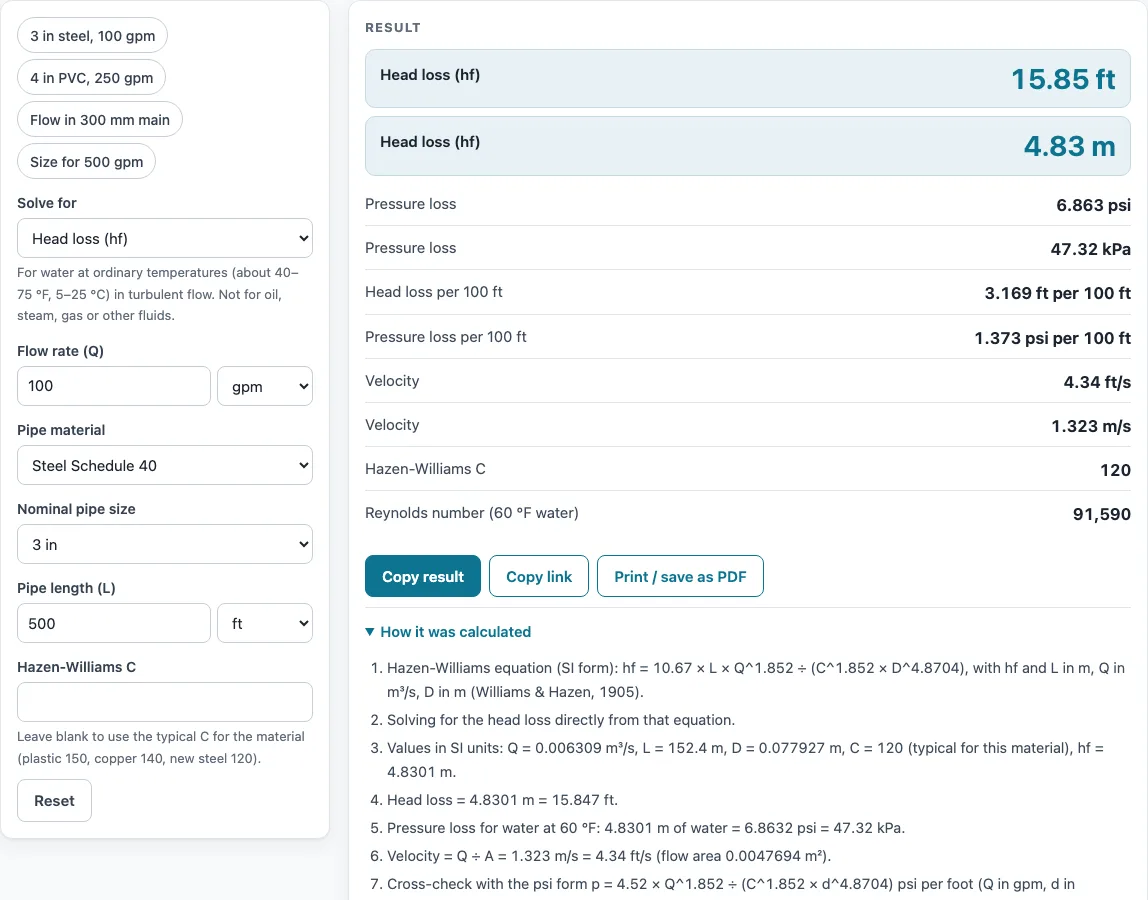
For example, 100 gpm through 500 ft of 3 in Schedule 40 steel (inside diameter 3.068 in) with C = 120 loses 15.85 ft of head, or 6.86 psi. To solve for another unknown, the equation is rearranged. Solving for flow gives Q, solving for diameter gives D, and solving for C gives the roughness coefficient that matches a measured loss. Because the equation is an empirical fit, it is only reliable for water at about 40 to 75 °F (5 to 25 °C) in turbulent flow. It does not apply to oil, steam or gas, and it ignores the effects of temperature and viscosity.
Sources
- Williams & Hazen, Hydraulic Tables (1933); SI constant 10.67 and exponents 1.852 and 4.8704
- NFPA 13 psi form p = 4.52 Q^1.852 / (C^1.852 d^4.8704) used as a cross-check
- C values: Uni-Bell (PVC 150), Toro Hazen-Williams table, ACADS HW coefficient table (AS 2118 and NZS 4541)
- C values for copper and stainless steel (150): NFPA 13, Installation of Sprinkler Systems, Hazen-Williams C values table (Table 28.2.4.8.1 in recent editions; numbering varies by edition), as reproduced by the Building Code Resource Library and the Canutesoft sprinkler hydraulics guide (both checked 2026-10-11)
- Validity range (40–75 °F water, turbulent flow, about 10 ft/s) is a common rule of thumb; FM Global Data Sheet 2-0 allows higher velocities
Results are for estimation; verify critical designs against the applicable standard.
Worked examples
| Input | Result |
|---|---|
| 100 gpm through 3.068 in pipe, 500 ft, C = 120 | 15.85 ft (6.86 psi) |
| 250 gpm through 4.026 in pipe, 1000 ft, C = 150 | 30.46 ft (13.2 psi) |
| 11.81 in pipe, 1500 m, C = 130, head loss 12 m | 1,784 gpm (112.6 L/s) |
| 500 gpm, 1000 ft, C = 120, head loss 5 psi | 6.961 in (176.8 mm) |
| 400 gpm through 6 in pipe, 800 ft, head loss 20 ft | C = 93.5 |
Calculated by the tool above with these values.
Frequently asked questions
Can I use the results in commercial projects or client reports?
Yes. You may use results in quotes, design notes, reports and client work without attribution. The page states that results are for estimation, so verify critical designs against the applicable standard. The calculator does not certify compliance with any code.
Is the calculator free, and is anything I type uploaded?
The calculator is free and needs no account or sign-up. Everything is calculated in your browser, and nothing you type is uploaded.
Can I print or share a calculation?
Yes. Print / save as PDF produces a one-page record with the inputs, results, calculation steps and date. Copy link copies a page address that stores your inputs, so the same calculation reopens later or can be sent to a colleague.
What value is used if I leave C blank?
The typical value for the material is used: 150 for plastic pipes (PVC, PEX and HDPE), 150 for copper tube, 150 for stainless steel and 120 for new steel. The copper and stainless values are the ones in the NFPA 13 Hazen-Williams C table (copper tubing in wet systems, stainless steel in all system types). Other published tables differ by source (Toro lists 140 for welded steel and 130 for copper; ACADS suggests 120 for steel; AS 2118 and NZS 4541 give copper 140), so type your own C when your specification names one. The C value used is shown in the result.
Does the calculator include fittings and valves?
No. Add the equivalent length of fittings and valves to the pipe length before you calculate.
Should I use Hazen-Williams or Darcy-Weisbach?
Hazen-Williams is quick and widely used for cold water in pressure pipes. For other liquids, hot water or laminar flow, use the Darcy-Weisbach method in the pressure drop calculator, which accounts for viscosity and temperature.
Related tools
- PVC Pipe Sizing Calculator and Chart : use it when you want to choose a pipe size for a given flow.
- Compressed Air Pipe Sizing Calculator : use it for air lines rather than water pipes.
- Cv Calculator (Valve Flow Coefficient) : use it to find the flow coefficient of a valve.
- Flow Rate Calculator : use it to convert between flow rate and volume over time.
- Gas Pipe Sizing Calculator (Natural Gas and Propane) : use it for natural gas or propane lines.
- GPM Calculator (Gallons per Minute) : use it to work out gallons per minute from other flow units.
- Mass Flow Rate Formula and Calculator : use it when you need flow by mass rather than volume.
- All pipe, pump and valve calculators : use it to browse the full set of tools.