GPM Calculator (Gallons per Minute)
Work out gallons per minute from a bucket test, from pressure through a nozzle, from pipe velocity, or convert between gpm, L/min, cfs and m³/h.
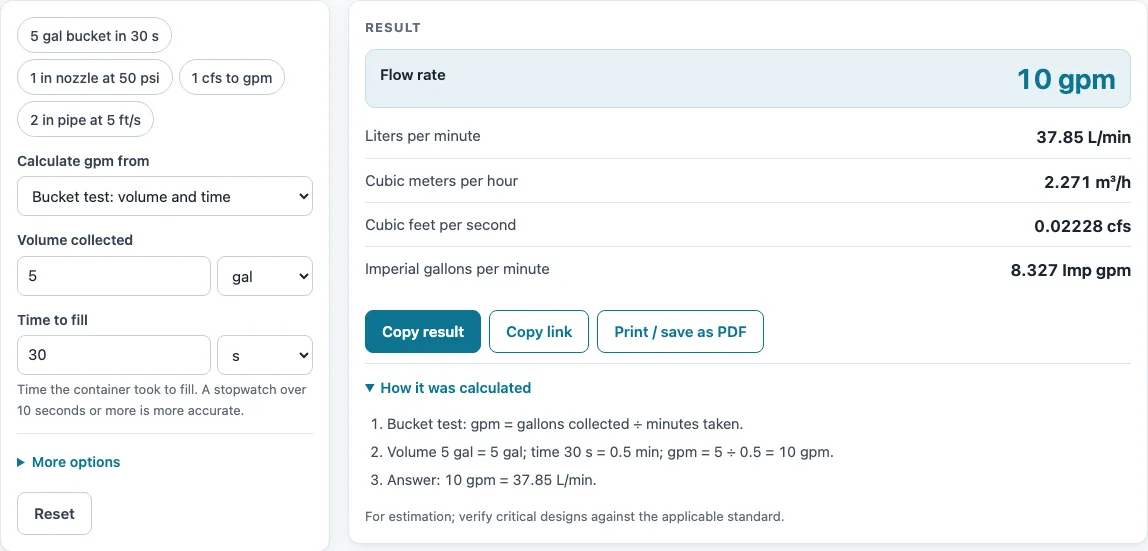
How to use the GPM Calculator
- Under Calculate gpm from, choose the mode that matches what you measured: bucket test, pressure at a nozzle or orifice, flow through a nozzle, unit conversion, or pipe velocity with inside diameter.
- With a bucket test, enter the volume collected and the time taken. Volume can be in gal, L, qt, fl oz, mL or m3, and time in seconds or minutes.
- Nozzle modes need the nozzle diameter in in, mm, cm or ft, plus the pressure in psi, bar or kPa. Pressure is the gauge pressure measured just behind the opening while water flows.
- Conversion works from the flow value and its unit: gpm, L/min, m3/h, cfs, Imperial gpm, L/s or cfm.
- In pipe mode, type the velocity in ft/s and the inside diameter of the pipe.
- Set each quantity’s unit in its own menu. You can mix metric and US customary units because the tool converts them before calculating.
- Read the result. It updates as you type. Open “How it was calculated” under the result to see the formula, the values substituted and the answer with units.
Preset buttons above the form load typical cases, and Reset restores the starting example. Less common inputs sit under More options. Copy result places the result lines and a link on the clipboard, while Copy link grabs the page address; it stores every input so the calculation reopens later. Print / save as PDF creates a one-page record with the inputs, results, steps and date.
How do you calculate gpm?
To work out gpm from a bucket test, divide the gallons collected by the minutes taken: gpm = gallons ÷ minutes. For instance, 5 gal in 30 s is 5 ÷ 0.5 = 10 gpm, or 37.85 L/min, so convert seconds to minutes first.
When sizing a nozzle, the calculator relies on the smooth-bore formula GPM = 29.84 × Cd × d² × √P, with d in inches and P in psi (Freeman fire-service hydraulics). Cd is the discharge coefficient. The default is 0.97, a round value slightly below the fire-service smooth-bore constant (published charts use 29.7 instead of 29.84, which is about Cd 0.995), and a sharp-edged hole is about 0.61. A 1 in nozzle at 50 psi gives 29.84 × 0.97 × 1² × √50 = 204.7 gpm.
Pressure by itself won’t fix a flow rate. The opening’s size matters too, since flow depends on a known diameter and coefficient.
Pipe flow uses GPM = 2.448 × v × d², where v is in ft/s and d in inches. It is Q = A × v with the unit factors folded in. Take a 2 in inside-diameter pipe at 5 ft/s: 2.448 × 5 × 2² = 48.96 gpm.
How do you calculate gallons per minute from pressure?
To find gallons per minute from a required nozzle pressure, apply the nozzle formula and solve for flow. Going the other way, from a target flow to the pressure it needs, rearrange to P = (GPM ÷ (29.84 × Cd × d²))². For example, 250 gpm through a 1.25 in nozzle with Cd 0.97 needs 30.56 psi, or 2.11 bar.
Conversions rely on fixed factors. A US gallon equals 3.785411784 L. A cubic foot per second (cfs) equals 448.83 gpm. The Imperial gallon measures 4.54609 L (NIST SP 811). So 100 L/min is 100 ÷ 3.785 = 26.42 gpm, and 1 cfs is about 448.8 gpm, or 1,699 L/min.
A pipe result above 20 ft/s raises a warning, since velocities that high usually signal a design problem.
Sources
- Unit factors: NIST SP 811
- Nozzle flow: Freeman form Q = 29.84 Cd d² √P (fire-service charts use 29.7, Colorado DFPC pump chart)
- Pipe form GPM = 2.448 v d²: Crane TP-410
These results are estimates, so check critical designs against the applicable standard.
Worked examples
| Input | Result |
|---|---|
| 5 gal collected in 30 s | 10 gpm (37.85 L/min) |
| 1 in nozzle at 50 psi, Cd 0.97 | 204.7 gpm (774.8 L/min) |
| 250 gpm through a 1.25 in nozzle, Cd 0.97 | 30.56 psi (2.11 bar) |
| 1 cfs | 448.8 gpm (1,699 L/min) |
| 100 L/min | 26.42 gpm (100 L/min) |
| v = 5 ft/s, pipe ID 2 in | 48.96 gpm (185.3 L/min) |
Calculated by the tool above with these values.
Frequently asked questions
Can I use the results in commercial projects or client reports?
Yes. You may use results in commercial work, such as quotes, design notes, reports and client projects, without attribution. Treat the result as an estimate: the tool does not certify compliance with any code, so check critical designs against the applicable standard.
Is the GPM Calculator free, and is anything I type uploaded?
There is no charge and no account or sign-up. Every calculation runs in your browser, and nothing you type is uploaded.
Can I print or share a calculation?
Yes, in two ways. Print / save as PDF produces a one-page record, while Copy link stores your inputs in the page address so a colleague can open the same calculation.
How to calculate gpm of a pump?
To measure it, run the pump into a container of known size and time the fill. Then use the bucket test mode: gpm = gallons collected ÷ minutes. A 5 gal bucket filled in 30 s, for instance, means 10 gpm. Take the reading at the outlet you care about, since flow shifts with the head the pump works against.
Why does the calculator warn when the bucket fill time is under 5 seconds?
A very short fill leaves little time to measure, so a small error in starting or stopping the timer has a large effect on the gpm result. A longer fill gives a more reliable reading.
What discharge coefficient should I use for a nozzle?
The default is 0.97, a round value slightly below the fire-service smooth-bore constant (about 0.995). If your nozzle maker publishes a coefficient, enter that instead. A sharp-edged hole comes in around 0.61. The calculator flags any Cd outside 0.5 to 1.0 with a warning.
Related tools
- PVC Pipe Sizing Calculator and Chart: pick a pipe size that fits a target flow and an allowable velocity.
- Compressed Air Pipe Sizing Calculator: choose this for compressed air lines, since the fluid is not water.
- Cv Calculator (Valve Flow Coefficient): relates the flow passing through a valve to the pressure drop across it.
- Flow Rate Calculator: handles flow in other units or scenarios, beyond water in gallons per minute.
- Gas Pipe Sizing Calculator (Natural Gas and Propane): helpful when sizing a natural gas or propane line.
- Hazen Williams Formula Calculator: gives a friction head loss estimate for water pipes.
- Mass Flow Rate Formula and Calculator: suited to flow measured by mass instead of volume.
- All pipe, pump and valve calculators: lists every pipe, pump and valve calculator on the site for browsing.