Gas Pipe Sizing Calculator (Natural Gas and Propane)
Enter the appliance load in BTU/h, the longest run and the allowed pressure drop to get the gas line size, with a capacity chart computed from the published sizing equations.
How to use the Gas Pipe Sizing Calculator
- Click a preset button above the form to load a typical case, or leave the starting example in place.
- Under Gas, choose natural gas or propane (LP gas).
- Enter the total load in MBH, BTU/h or kW. Use the unit menu beside the field to pick the unit.
- Enter the longest run of pipe in ft or m.
- Enter the inlet gauge pressure in in w.c., psi, kPa or mbar.
- Choose the material: Schedule 40 steel, or copper tube Type L or K.
- Open More options only if you need to change the allowed pressure drop or the heating value. The defaults apply otherwise.
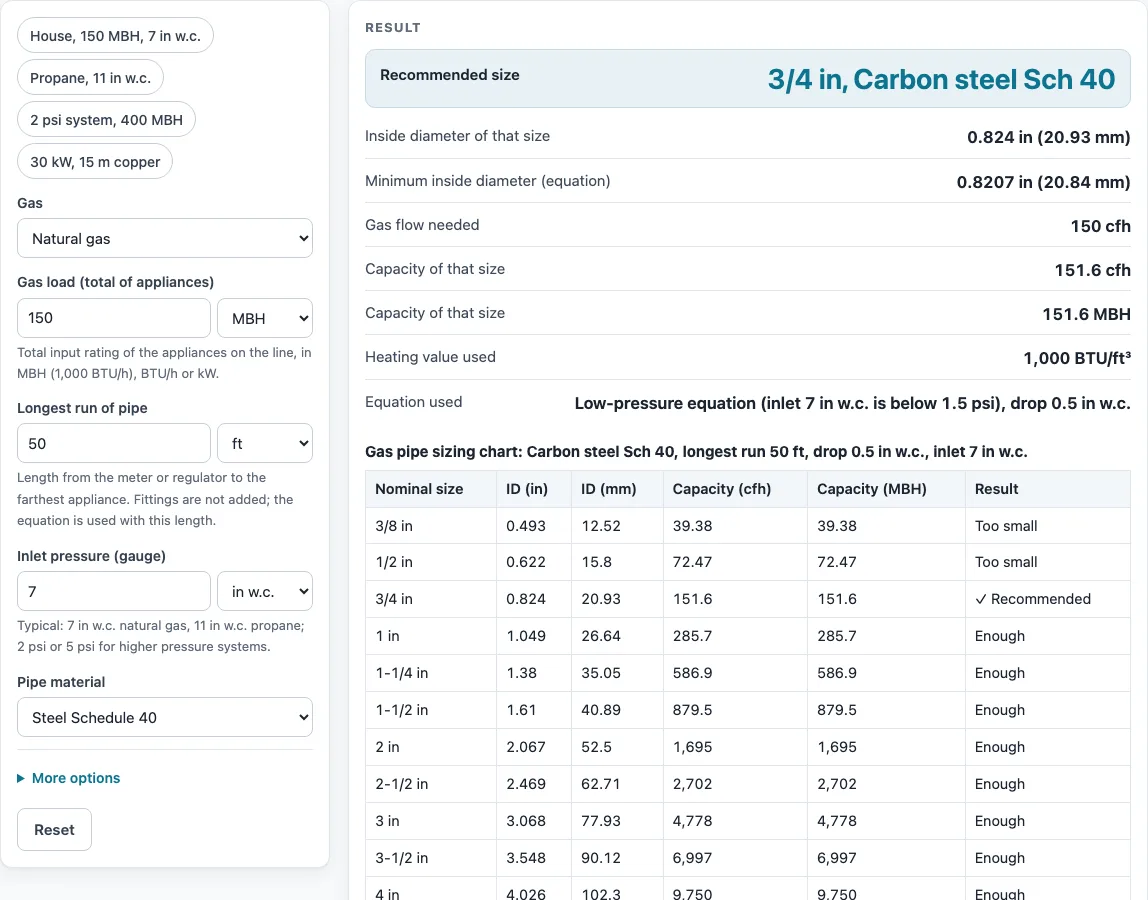
- Read the result. It shows the recommended nominal size, its inside diameter, the minimum inside diameter from the equation, the gas flow in cfh, the capacity of the recommended size, and which equation applied.
- Check the size table below the result. The recommended size is marked ✓ Recommended, and every other size is marked Enough or Too small.
- Open “How it was calculated” to see the formula, the values substituted and the answer with units.
The result updates as you type. Reset restores the starting example. Copy result copies the result lines with a link, and Copy link copies a page address that stores every input, so the same calculation reopens later. Print / save as PDF creates a one-page record with the inputs, results, steps and date.
What is the gas pipe sizing formula?
The calculator solves one equation for the inside diameter, and the equation depends on the inlet pressure. Below 1.5 psi, the low-pressure equation applies: D = Q^0.381 ÷ (19.17 × (ΔH ÷ (Cr × L))^0.206). From 1.5 psi up, the high-pressure equation applies: D = Q^0.381 ÷ (18.93 × ((P1² − P2²) × Y ÷ (Cr × L))^0.206).
D is the inside diameter in inches, Q is the gas flow in cfh, ΔH is the allowed pressure drop in inches of water column, and L is the pipe length in feet. In the high-pressure equation, P1 and P2 are absolute pressures in psia, found by adding 14.7 psi to the gauge pressure. The gas factors are Cr = 0.6094 and Y = 0.9992 for natural gas, and Cr = 1.2462 and Y = 0.9910 for undiluted propane. Y appears only in the high-pressure equation.
How is gas line sizing capacity calculated?
Gas flow starts from the load. Flow in cfh equals the load in BTU/h divided by the heating value in BTU/ft³. The default heating values are 1,000 BTU/ft³ for natural gas and 2,516 BTU/ft³ for propane.
Pipe capacity uses the same equations solved for flow: Q = (19.17 × D)^(1 ÷ 0.381) × (ΔH ÷ (Cr × L))^(0.206 ÷ 0.381). The calculator takes the minimum inside diameter from the sizing equation, then selects the smallest standard size whose real inside diameter meets it. Real inside diameters come from ASME B36.10M for steel and ASTM B88 for copper.
For example, take 150 MBH of natural gas over a 50 ft run, with 7 in w.c. inlet pressure and a 0.5 in w.c. allowed drop, in Schedule 40 steel. The flow is 150,000 ÷ 1,000 = 150 cfh. The equation gives a minimum inside diameter of 0.8207 in. A 3/4 in pipe (inside diameter 0.824 in) meets that, with a capacity of 151.6 cfh. A 1 in pipe would carry 285.7 cfh over the same 50 ft, so it is oversized for this load.
Sources
- International Fuel Gas Code (ICC) section 402.4, Equations 4-1 and 4-2 and Table 402.4 (Cr and Y), read from the public City of Seattle copy of IFGC chapter 4
- NFPA 54 uses the same equations
- Heating values 1,000 BTU/ft³ natural gas and 2,516 BTU/ft³ propane; pipe dimensions: see the Pipe Schedule Chart sources
Results are for estimation; verify critical designs against the applicable standard.
Worked examples
| Input | Result |
|---|---|
| Natural gas, 150 MBH, longest run 50 ft, inlet 7 in w.c., Carbon steel Sch 40 | 3/4 in, Carbon steel Sch 40, ID 0.824 in, capacity 151.6 cfh |
| Propane (LP gas), 100 MBH, longest run 40 ft, inlet 11 in w.c., Carbon steel Sch 40 | 1/2 in, Carbon steel Sch 40, ID 0.622 in, capacity 55.54 cfh |
| Natural gas, 400 MBH, longest run 100 ft, inlet 2 psi, Carbon steel Sch 40 | 1/2 in, Carbon steel Sch 40, ID 0.622 in, capacity 459.6 cfh |
| Natural gas, 30 kW, longest run 15 m, inlet 7 in w.c., Copper tube Type L | 3/4 in, Copper tube Type L, ID 0.785 in, capacity 134.6 cfh |
| Propane (LP gas), 600000 BTU/h, longest run 120 ft, inlet 5 psi, Carbon steel Sch 40 | 1/2 in, Carbon steel Sch 40, ID 0.622 in, capacity 308.7 cfh |
Calculated by the tool above with these values.
Frequently asked questions
Can I use the results in commercial projects or client reports?
Yes. You can use results in commercial work, including quotes, design notes, reports and client projects, without giving attribution.
Is the calculator free, and is anything I type uploaded?
The calculator is free. All calculations run in your browser, nothing you type is uploaded, and there is no account or sign-up.
Can I print or share a calculation?
Yes. Print / save as PDF makes a one-page record with the inputs, results, steps and date, and Copy link copies a page address that stores every input, so a colleague can open the same gas line sizing.
Is there a gas pipe sizing chart for natural gas or propane?
Yes. Below the main result, a table gives the capacity in MBH of every pipe size for lengths of 10, 20, 30, 40, 50, 60, 80, 100, 150 and 200 ft. You can use it to compare sizes at standard lengths without entering each one.
Why might my result differ from my local code table?
The calculator applies the published sizing equations, not the code’s printed tables. The sizing tables in the adopted code and the rules of your local gas utility govern your installation.
What do the warnings mean?
The calculator warns you when the inlet pressure is above 5 psi, when the allowed drop is above half the inlet pressure, when the longest run is shorter than 5 ft or longer than 1000 ft, when the load is very large, or when no listed size is large enough. Check your inputs when a warning appears.
Related tools
- Pipe Schedule Chart and Pipe Size Lookup: use it to check the wall thickness and inside diameter of a pipe size before you finalize a choice.
- Pipe Flow Calculator: use it to estimate flow and pressure loss in liquid or gas lines outside the fuel gas scope of this tool.
- Pipe Velocity Calculator: use it to check how fast a fluid moves through a chosen pipe size.
- Steam Pipe Sizing Calculator: use it when you size steam lines instead of fuel gas lines.
- Compressed Air Pipe Sizing Calculator: use it when you size compressed air distribution piping.
- All pipe, pump and valve calculators: use it to browse the rest of the calculator set.