Compressed Air Pipe Sizing Calculator
Enter the air flow, operating pressure, pipe length and the pressure drop you can accept to get the smallest compressed air line size.
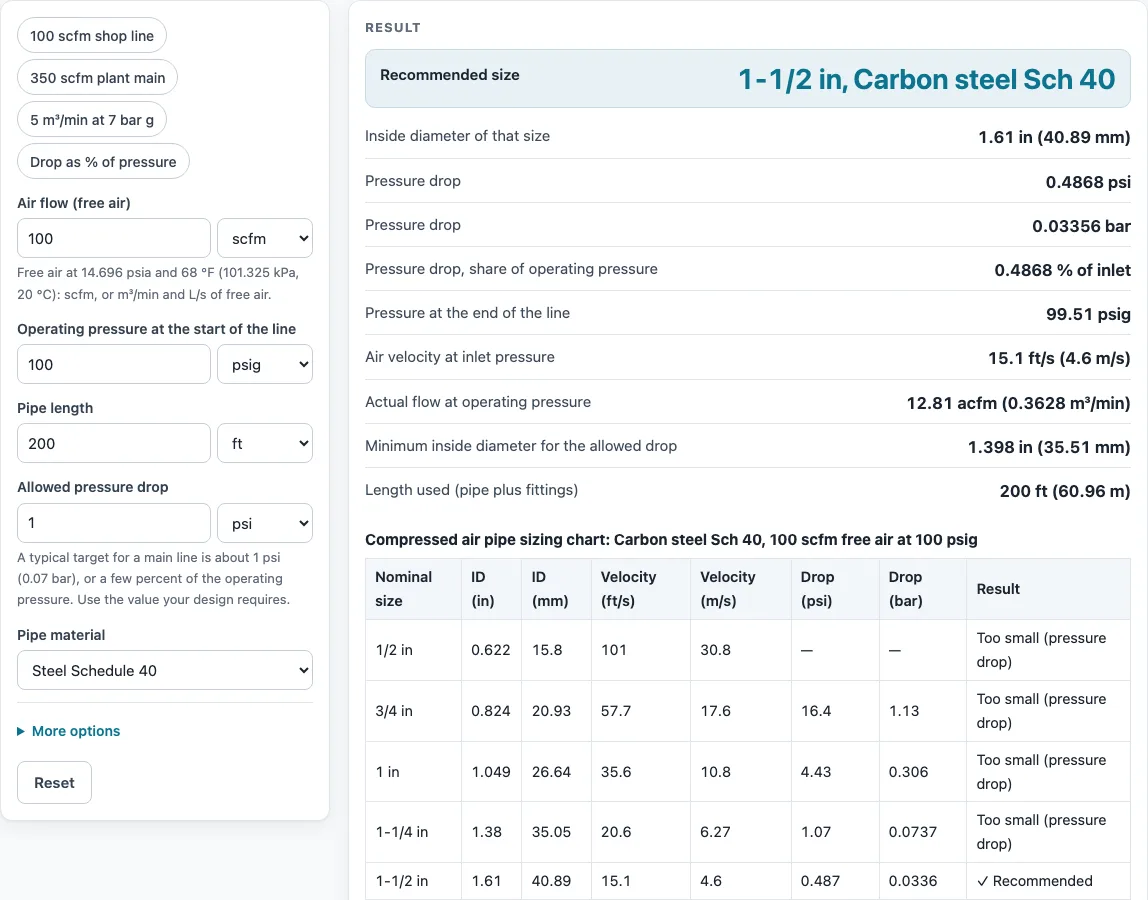
How to use the Compressed Air Pipe Sizing Calculator
- Start with a preset above the form if one fits: 100 scfm shop line, 350 scfm plant main, 5 m³/min at 7 bar g, or a drop given as a percent of pressure. Otherwise, overwrite the starting example.
- Enter the free-air flow and choose its unit: scfm, m³/min, L/s, m³/h or L/min.
- Enter the operating pressure at the start of the line and choose psig, bar g or kPa g.
- Enter the pipe length and choose ft or m.
- Enter the allowed pressure drop and choose psi, bar, kPa or % of inlet gauge pressure.
- Select the material and pipe type: Schedule 40 or Schedule 80 steel, or copper Type L or Type K.
- If needed, open More options. There you can add the equivalent length of fittings and valves, set a maximum velocity, or change the air temperature (default 68 °F) and site atmospheric pressure (default 14.696 psia).
- Read the result: recommended size, inside diameter, pressure drop, end pressure, velocity and actual flow. The result updates as you type. Check the sizing chart for each size’s status and any warnings.
- Open “How it was calculated” to see the formula, the values substituted and the answer with units.
Use Copy result to copy the result lines with a link, or Copy link to copy the page address, which stores all your inputs. Print / save as PDF gives a one-page record of inputs, results, steps and the date. Reset returns to the starting example.
What pressure drop is allowed in a compressed air line?
The default allowed drop is 1 psi (0.07 bar), inside the 0.1 bar between compressor and the most remote point that Atlas Copco recommends. It is a plain input and not a code value, so set the limit your design needs. You can enter it in psi, bar, kPa or as a percent of inlet gauge pressure.
How does the calculator work out the pressure drop?
The calculator uses the Darcy-Weisbach equation for isothermal flow of an ideal gas: P₁² − P₂² = f × (L ÷ D) × G² × R × T, with the Colebrook-White friction factor. The kinetic-energy term is neglected. Free-air flow is converted to mass flow using a reference density, ρ = P ÷ (R × T) with R = 287.05 J/(kg·K). The reference is 14.696 psia and 68 °F for dry air. Some suppliers use 60 °F or 14.5 psia, which changes the flow by about 1 to 2 %. Air viscosity comes from Sutherland’s law, about 1.81e-5 Pa·s at 20 °C. Pipe roughness is 0.045 mm for steel and 0.0015 mm for copper.
What does the compressed air pipe sizing chart show?
The chart lists each size with its inside diameter, velocity (ft/s and m/s), and pressure drop (psi and bar). Each row has a status: ✓ Recommended, OK, larger, or too small by pressure drop or velocity. Warnings appear for a velocity above 9 m/s (about 30 ft/s), a pressure drop above 10 % of operating pressure, no size large enough, a very short length, or a pressure above 20 bar g. Atlas Copco recommends 6 to 7 m/s or less in main headers and never more than 9 m/s, so treat 9 m/s as an upper limit, not a target; a lower velocity gives less pressure drop and less noise.
How do fittings and pipe length affect the size?
Pipe length and fittings both add resistance, so the calculator adds the equivalent length of fittings and valves to the pipe length. For example, a run of 500 ft with 100 ft of fitting equivalent is sized as 600 ft. Longer runs need a larger diameter to keep the same drop.
Which pipe materials can I use for compressed air?
The calculator offers Schedule 40 and Schedule 80 steel, and copper Type L and Type K, in sizes NPS 1/2 to 12 for steel and up to 6 for copper. PVC is not offered because manufacturers do not approve it for compressed air.
Sources
- Isothermal flow of an ideal gas with friction (White, Fluid Mechanics, section 9.5; Crane TP-410)
- Velocity and pressure drop guidance: Atlas Copco “Sizing compressed air pipe” (6–7 m/s, never above 9 m/s, 0.1 bar total)
- PVC is not offered: Charlotte Pipe warns never to use PVC for compressed air or gas
- Air viscosity: Sutherland’s law (White, Table 1.2); pipe dimensions: see the Pipe Schedule Chart sources
Results are for estimation; verify critical designs against the applicable standard.
Worked examples
| Input | Result |
|---|---|
| 100 scfm free air at 100 psig, 200 ft of Carbon steel Sch 40, allowed drop 1 psi | 1-1/2 in, Carbon steel Sch 40; drop 0.487 psi, 15.1 ft/s (4.6 m/s) |
| 350 scfm free air at 125 psig, 500 ft of Carbon steel Sch 40, allowed drop 1 psi | 3 in, Carbon steel Sch 40; drop 0.502 psi, 12 ft/s (3.64 m/s) |
| 5 m³/min free air at 7 bar g, 100 m of Copper tube Type L, allowed drop 0.1 bar | 2 in, Copper tube Type L; drop 0.65 psi, 17.3 ft/s (5.28 m/s) |
| 25 scfm free air at 100 psig, 60 ft of Copper tube Type L, allowed drop 1 psi | 3/4 in, Copper tube Type L; drop 0.31 psi, 15.9 ft/s (4.84 m/s) |
| 1000 scfm free air at 110 psig, 1000 ft of Carbon steel Sch 40, allowed drop 3 % of inlet | 4 in, Carbon steel Sch 40; drop 1.79 psi, 22.2 ft/s (6.77 m/s) |
Calculated by the tool above with these values.
Frequently asked questions
Can I use the results in commercial projects or client reports?
Yes. Results may be used in commercial work, including quotes, design notes, reports and client projects, without attribution. The page says “For estimation; verify critical designs against the applicable standard.” The tool does not certify compliance with any code.
Is the calculator free, and is anything I type uploaded?
Yes, the calculator is free and needs no account or sign-up. Everything is calculated in your browser, and nothing you type is uploaded.
Can I print or share a calculation?
Yes. Print / save as PDF creates a one-page record with the inputs, results, calculation steps and date. Copy link stores every input in the page address (in the ?s= part of the URL), so the same calculation reopens later or can be sent to a colleague.
Can I mix metric and US units in one calculation?
Yes. Each quantity has its own unit menu, so you can enter flow in m³/min, pressure in psig and length in ft. The tool converts all values before it calculates.
Why is PVC not in the material list?
PVC pipe is not offered because manufacturers do not approve it for compressed air. Steel and copper are the materials the calculator sizes.
Related tools
- Gas Pipe Sizing Calculator: use it for natural gas and propane lines instead of compressed air.
- Steam Pipe Sizing Calculator: use it when the line carries steam.
- Pipe Flow Calculator: use it to work out flow and head loss for liquids in a pipe.
- Pipe Schedule Chart and Pipe Size Lookup: use it to check wall thickness and inside diameters for steel pipe schedules.
- Pipe Velocity Calculator: use it to check the velocity of a flow in a given pipe size.
- Relief Valve Sizing Calculator: use it when you need to size a relief valve for a pressure system.
- PVC Pipe Sizing Calculator and Chart: use it for PVC pipe sizing and other water-system pipe sizing.
- All pipe, pump and valve calculators: use it to browse every calculator on the site.