PVC Pipe Sizing Calculator and Chart
Enter the flow rate and pick a pipe material to get the smallest size that keeps velocity and friction loss within your limits, with a sizing chart of every size.
Popular tools
- Pipe Schedule Chart and Pipe Size LookupLook up one pipe size and schedule for its outside diameter, wall, inside diameter, flow area and weight, or print the full chart.
- Steam Table Calculator (Saturated and Superheated Steam)Type a pressure or temperature to read the steam properties from the IAPWS-IF97 equations, or print a full saturated steam table.
- Flow Rate CalculatorFind the volumetric flow rate from velocity and pipe size, from a volume and a time, from a channel's width and depth, or from mass flow and density.
- Pipe Velocity CalculatorEnter the flow rate and the pipe size or inside diameter to get the flow velocity, or switch to find the flow rate from a velocity.
How to use the Pipe Sizing Calculator
- Enter the flow rate and pick its unit from the menu beside it. Options include gpm, L/s, L/min, m³/h, cfs and MGD.
- Choose the pipe material. For PVC, pick Schedule 40 or Schedule 80.
- Set the maximum velocity in ft/s or m/s. The default is 5 ft/s (1.5 m/s), which is your design limit, not a code limit.
- Open More options if you want a friction limit. Enter a value in psi, ft, kPa or m per 100 ft or 100 m, and set the water temperature in °F or °C.
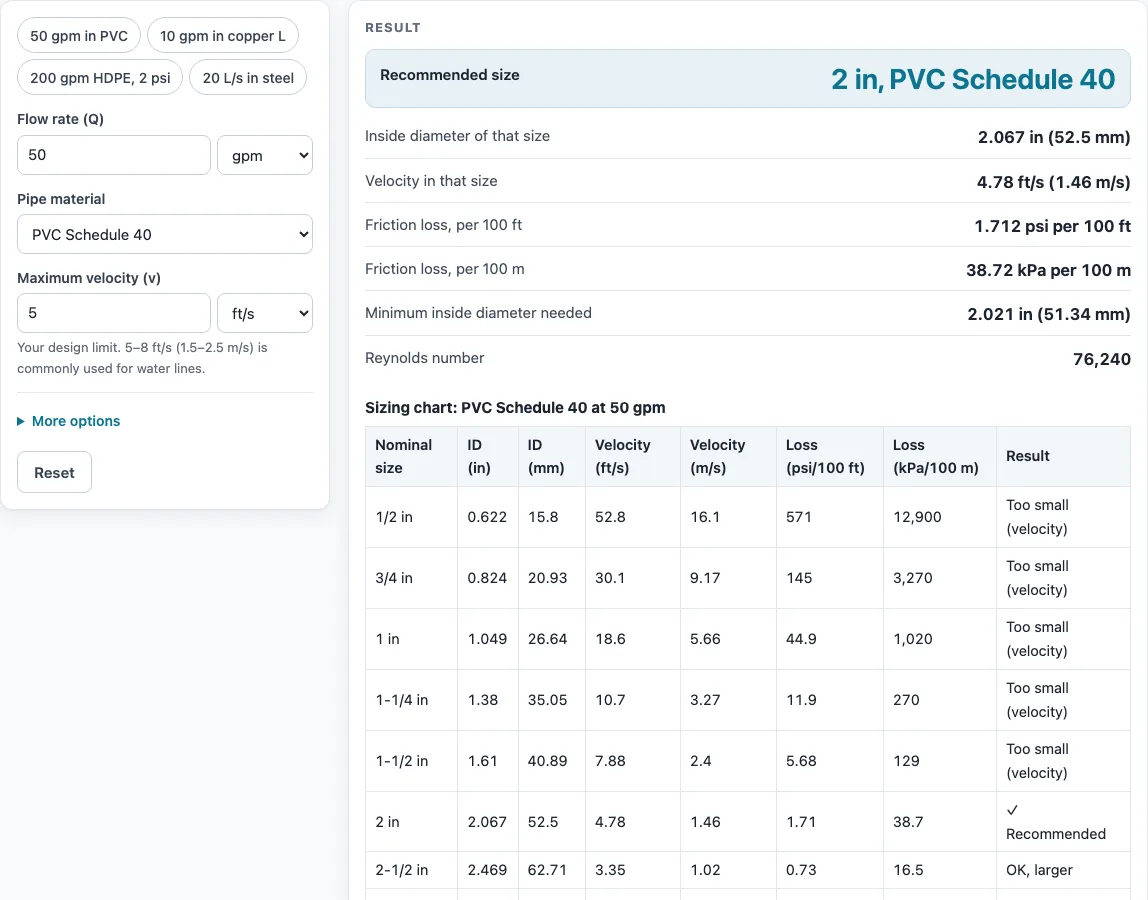
- Read the recommended size. The result shows its inside diameter, velocity, friction loss per 100 ft or 100 m, and the minimum inside diameter needed.
- Check the sizing chart. The row marked ✓ Recommended is your pick, and the other rows say OK, larger, or too small by velocity or friction.
The result updates as you type. Under it, How it was calculated shows the formula, the values used and the answer with units. Use the preset buttons above the form to load typical cases, or Reset to return to the starting example. Copy link saves every input in the page address, so you can reopen the same calculation later or send it to a colleague. Copy result copies the result lines with that link. Print / save as PDF produces a one-page record with the inputs, results, steps and date.
How do you calculate pipe diameter for a water line?
Pipe diameter comes from the flow rate and the velocity you allow. The tool uses D = √(4Q ÷ (π × v)), where Q is flow rate and v is the maximum velocity. The result is the minimum inside diameter, which the calculator shows in inches and millimetres as “Minimum inside diameter needed.”
Take 50 gpm with a 5 ft/s limit. The calculator returns a minimum inside diameter of 51.34 mm (2.021 in). The smallest PVC Schedule 40 size with enough inside diameter is 2 in nominal, which has an inside diameter of 2.067 in (52.50 mm).
What velocity limit should you use for PVC water pipe?
The velocity limit is your design choice. The default is 5 ft/s (1.5 m/s), and 5 to 8 ft/s (1.5 to 2.5 m/s) is the range commonly used for water lines. Lower velocities mean larger pipe, less noise and lower friction. Higher velocities mean smaller pipe and higher friction. Warnings appear above about 10 ft/s (3 m/s).
How is friction loss in PVC pipe calculated?
Friction loss uses the Darcy-Weisbach equation, Δp/L = f × ρ × v² ÷ (2D). The friction factor f comes from the Colebrook-White equation and the absolute roughness of the material. PVC, copper, PEX and HDPE use the smooth drawn-tubing value 0.0015 mm, and steel uses 0.045 mm (Moody; Crane TP-410). At 50 gpm in 2 in PVC Schedule 40, the velocity is 4.78 ft/s (1.46 m/s) and the friction loss is 1.71 psi per 100 ft (38.7 kPa per 100 m).
Why does the tool use the larger of two minimum diameters?
If you enter a friction limit, the calculator finds by bisection the smallest diameter whose friction loss does not exceed that limit. It then compares this with the velocity-based minimum and uses the larger of the two. A pipe that meets the velocity limit can still lose too much pressure over distance, so the bigger value controls the result.
Why does water temperature change the result?
Temperature changes water density and viscosity, and both enter the friction calculation. The default is 68 °F (20 °C), with a density of 998.2 kg/m³ and a viscosity of 1.002 mPa·s. The tool accepts temperatures from 0 to 100 °C. Plastic pipe has a temperature limit too: the calculator warns when PVC carries water above 140 °F (60 °C).
What does the sizing chart tell you?
The chart lists every size of the material you chose, with inside diameter, velocity and friction loss at your flow. PVC Schedule 40 has 15 sizes, from NPS 1/2 to 12. Nominal size is a name, not a measurement, so compare the inside diameter column when you check a size. A Reynolds number below 4000 means the flow is laminar or transitional, and the calculator warns you when that happens.
Sources
- Pipe dimensions: ASME B36.10M and B36.19M steel pipe (per manufacturer and distributor tables based on the standards), ASTM D1785 PVC minimum walls (Charlotte Pipe catalog), ASTM B88 copper tube, ASTM F876 PEX (SDR 9), HDPE DR 11 (Performance Pipe)
- Friction: Darcy-Weisbach with the Colebrook-White equation (White, Fluid Mechanics; Crane TP-410); roughness values from Moody (1944)
- Water properties: Kell (1975) density and IAPWS 2008 viscosity (CRC Handbook; checked against the NIST Chemistry WebBook)
- PVC temperature derating: University of Florida IFAS publication AE066
Results are for estimation; verify critical designs against the applicable standard.
Worked examples
| Input | Result |
|---|---|
| 50 gpm through PVC Schedule 40, velocity limit 5 ft/s | 2 in, PVC Schedule 40; 4.78 ft/s (1.46 m/s), 1.71 psi per 100 ft |
| 10 gpm through Copper tube Type L, velocity limit 5 ft/s | 1 in, Copper tube Type L; 3.89 ft/s (1.19 m/s), 2.8 psi per 100 ft |
| 200 gpm through HDPE DR 11 (IPS), velocity limit 8 ft/s, friction limit 2 psi/100 ft | 4 in, HDPE DR 11 (IPS); 6.03 ft/s (1.84 m/s), 1.29 psi per 100 ft |
| 20 L/s through Carbon steel Sch 40, velocity limit 1.5 m/s | 6 in, Carbon steel Sch 40; 3.52 ft/s (1.07 m/s), 0.299 psi per 100 ft |
| 8 gpm through PEX tubing SDR 9, velocity limit 6 ft/s | 1 in, PEX tubing SDR 9; 4.27 ft/s (1.3 m/s), 4.01 psi per 100 ft |
Calculated by the tool above with these values.
Frequently asked questions
Can I use the results in commercial projects or client reports?
Yes. Results may be used in commercial work, including quotes, design notes, reports and client projects, without attribution. The tool is for estimation, so verify critical designs against the applicable standard.
Is the calculator free, and is anything I type uploaded?
The calculator is free, and there is no account or sign-up. Everything is calculated in your browser, and nothing you type is uploaded.
Can I print or share a calculation?
Yes. Print / save as PDF produces a one-page record with inputs, results, calculation steps and the date. Copy link stores your inputs in the page address, so the same calculation reopens later or can be sent to a colleague.
Can I use this to size PVC for hot water?
The calculator warns when PVC carries water above 140 °F (60 °C). Above that temperature, choose a different material from the list, and check the design against the applicable standard.
Does a result show that my pipe meets plumbing code?
No. The tool does not certify compliance with any code. It finds a size that meets the velocity and friction limits you enter, so check the final design against the standard that applies to your project.
Can I mix metric and US units in one calculation?
Yes. Each quantity has its own unit menu, so you can enter flow in L/s and the velocity limit in ft/s. The tool converts everything before it calculates.
What does “no listed size large enough” mean?
It means that none of the sizes for the chosen material meets your velocity or friction limit at the flow you entered. Lower the flow, raise the velocity limit or friction limit, or choose a material with a larger available range.
Related tools
- Compressed Air Pipe Sizing Calculator: use it when the fluid is compressed air rather than water.
- Cv Calculator (Valve Flow Coefficient): use it to find the flow coefficient of a valve in your line.
- Flow Rate Calculator: use it to convert a volume and time into a flow rate before sizing the pipe.
- Gas Pipe Sizing Calculator (Natural Gas and Propane): use it to size pipe for natural gas or propane lines.
- GPM Calculator (Gallons per Minute): use it to convert between gallons per minute and other flow units.
- Hazen Williams Formula Calculator: use it to check friction loss with the Hazen-Williams equation.
- Mass Flow Rate Formula and Calculator: use it when you know mass flow rather than volume flow.
- All pipe, pump and valve calculators: use it to browse the full set of tools on this site.